
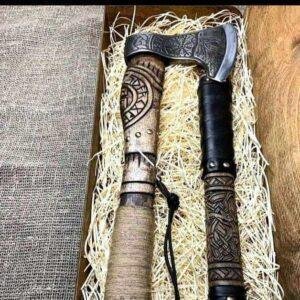
Viking Throwing Axe — History, Technique & Buying Guide
Introduction
Twenty metres away, a Norse skirmisher draws back his arm.
The shield wall has not yet clashed. The two armies are still sizing each other up — screaming war cries, beating axes against shields, working up the nerve to charge. In these last seconds before contact, both sides launch everything they have into the enemy line.
Arrows. Javelins. And spinning, end-over-end, a throwing axe moving too fast to track and too unpredictable to block.
It does not need to kill. It just needs to make one man flinch at the wrong moment — raise his shield too high, break step, lose his shoulder-to-shoulder lock with the man beside him. One gap in a shield wall is all it takes.
The Viking throwing axe was a precision disruption weapon, a ranged killing tool, and one of the most satisfying things a Norse warrior could learn to master. A thousand years later, it is also one of the fastest-growing sports in the world.
This is everything you need to know about it.
👉 Shop Viking throwing axes at Orion Krafts
The History of the Norse Throwing Axe
The Francisca Connection
The throwing axe was not exclusively a Viking invention. The Francisca — a short, curved throwing axe with a distinctive upswept blade — was used by Frankish warriors across Northern and Western Europe from at least the 5th century AD.
Norse raiders and traders came into direct contact with Frankish weapons throughout the Migration Period and early Viking Age. The influence flowed both ways. What emerged in Scandinavia was a distinctly Norse interpretation of the throwing axe concept — lighter, more balanced, and built for the specific tactical demands of Viking Age combat.
How It Fit Into Viking Battle Tactics
Viking armies did not fight in neat, Hollywood-style lines with axes clashing dramatically at range. They were pragmatic, tactical, and deeply experienced at managing the chaos of early medieval combat.
Before a shield wall engagement, both sides typically exchanged a hail of missile weapons. Arrows came first. Then javelins. Then, at closer range — 10 to 20 metres — throwing axes.
At that distance, a spinning axe is difficult to track and nearly impossible to block cleanly with a shield. Even if it strikes the shield face-on, the weight and rotation can split the wood, crack the boss, or simply knock the man holding it off balance. In a shield wall, off-balance is as good as dead.
The psychological effect was just as important as the physical one. A volley of throwing axes descending on a tightly packed formation is terrifying. Men instinctively raise their shields. Their vision goes dark. The charging Norse line hits them half-blind.
The Warriors Who Threw
Norse sagas specifically celebrate warriors who could throw with devastating accuracy. In Egil’s Saga, Egil Skallagrímsson is described dispatching enemies at range with thrown axes during several engagements. The King’s Mirror — a 13th-century Norwegian text — lists axe throwing among the skills every warrior should develop.
This was not a casual skill. Accuracy at 10 metres with a spinning, weighted weapon takes hours of dedicated practice. The Norse warriors who mastered it were considered elite, and their ability was specifically noted alongside other markers of warrior distinction — swordsmanship, strength, sailing.
The ability to throw an axe and hit what you were aiming at, under pressure, in the chaos before a shield wall collision, was the Viking Age equivalent of being a sharpshooter.
The Design: What Makes a Good Throwing Axe
Not every axe is a throwing axe. Using a heavy bearded axe or Dane Axe for throwing is both ineffective and dangerous. The throwing axe is its own tool — engineered specifically around the physics of rotational flight.
Weight: The Critical Variable
A Norse throwing axe needs to be light enough to carry multiple on the body but heavy enough to hit with force at range.
The sweet spot is 300 to 600 grams for the head. Total axe weight — head plus haft — typically sits between 500g and 900g. Below that range, the axe lacks impact energy on arrival. Above it, the throw requires too much force to maintain accuracy at distance.
Modern sport throwing organisations, including the World Axe Throwing League (WATL) and National Axe Throwing Federation (NATF), have standardised competition axes at similar weights — not by coincidence, but because a millennium of practical use landed on the same optimal range.
Balance Point
For a throwing axe to rotate predictably in flight, the balance point must sit at a specific position relative to the total length of the weapon.
On a well-designed throwing axe, the balance point sits roughly one-third of the way up from the base of the haft — close enough to the head that the axe rotates around a consistent centre of gravity, far enough down the handle that the throw feels natural in the hand.
An axe that is too head-heavy rotates too fast and arrives blade-down inconsistently. Too handle-heavy and it tumbles unpredictably. Good balance is what separates a throwing axe from an axe someone threw.
Haft Length
The haft length of a Norse throwing axe was typically 35 to 55 centimetres — short enough to be carried on a belt or strapped to the body, long enough to generate rotation speed through the throw.
At this length, a standard one-and-a-half rotation throw lands the blade at approximately 3 to 4 metres. A full two-rotation throw — the standard competition distance — lands at 4 to 6 metres. Historical combat distances of 10 to 20 metres required either multiple rotations or experienced “no-spin” technique.
Blade Geometry
A throwing axe blade does not need the long cutting edge of a bearded axe or the mass of a battle axe. It needs a compact, sharp leading edge that bites into the target on contact.
The typical Norse throwing axe blade is relatively small — 8 to 14cm of cutting edge — with a pronounced point at the toe (upper corner of the blade) that catches the target even on slightly off-angle arrivals. The bearded axe’s hooked lower edge is not desirable in a throwing design — it can catch the air and disrupt the rotation.
How to Throw a Viking Axe: Technique Guide
Axe throwing looks spectacular. It is also, with proper technique, surprisingly learnable. Most people land their first clean stick within 30 minutes of focused practice. Here is the complete technique breakdown.
Safety First — Non-Negotiable Rules
Before anything else:
- Clear the range — nobody stands in front of or beside the throwing line while axes are in hand
- Inspect your axe before every session — check the haft for cracks, the head for looseness, the edge for chips that could cause deflection
- Never throw a loose head — a head that wobbles on the haft can separate mid-throw
- Retrieve axes one at a time — only approach the target when everyone has thrown and the range is called clear
- Closed-toe shoes, always — a dropped or deflected axe goes downward
Grip
Hold the axe at the base of the haft — your bottom hand should be at or near the end of the handle, not choked up toward the head.
Two-handed grip (recommended for beginners): Both hands wrap the haft at the base. The axe sits in your palms, not locked in a death grip — firm enough to control, relaxed enough that the haft can rotate naturally through the release.
One-handed grip (advanced): Dominant hand at the base of the haft. The throw mechanics are identical; the one-handed version simply requires more wrist control and developed rotation feel.
Keep your knuckles facing the target and your thumbs pointing up along the haft on the upswing. Avoid torquing the wrist during the throw — rotation comes from the axe’s own momentum, not from your hand.
Stance
Stand facing the target square-on. Feet shoulder-width apart. Dominant foot slightly back — a natural, relaxed fighting stance.
Your distance from the target determines how many rotations the axe completes before arrival. Learn the standard distances first:
| Rotations | Distance from Target |
|---|---|
| 1 full rotation | 3–4 metres |
| 1.5 rotations | 4–5 metres |
| 2 full rotations | 5–7 metres |
Most indoor axe-throwing venues set the target at 4.5 to 6 metres — one and a half to two rotations for a standard competition throw.
The Throw — Step by Step
1. Load up. Bring both hands (or your throwing hand) straight overhead. The axe should be nearly vertical above your head — blade pointing directly at the ceiling, haft pointing toward the ground behind you. Do not cock the axe sideways. Keep everything in line.
2. Keep your eyes on the target. Fix on the centre of the bullseye and do not look away. Your body follows your eyes.
3. Drive forward. Bring your arms down in a straight, vertical plane toward the target. Think of it less like throwing a ball and more like swinging a hammer directly forward — a straight, controlled downward drive.
4. Release at eye level. Let go when your hands reach approximately eye level on the follow-through. Too early (above eye level) and the axe rotates low — blade-down. Too late (below eye level) and the axe over-rotates — blade-up on arrival.
5. Follow through. Your hands should finish pointing directly at the target, level with your chest. Do not jerk or snap the wrist. The axe should leave your hands cleanly, with no spin imparted from your grip.
6. Listen for the stick. A clean landing makes a satisfying, solid thunk. An over-rotation hits handle-first and bounces. An under-rotation hits the top of the blade and deflects. Both tell you exactly what to adjust.
Common Faults and How to Fix Them
Axe consistently lands blade-up (over-rotation): Step half a pace closer to the target, or release slightly later in the follow-through.
Axe consistently lands blade-down (under-rotation): Step half a pace further back, or release slightly earlier.
Axe deflecting sideways: Your hands are not aligned — one hand is pulling more than the other, or you are torquing at the wrist. Focus on a straight, two-handed drive directly toward the centre of the target.
No stick at all — hitting flat: The edge angle on arrival is too shallow. Ensure you are driving the throw at the target, not over it. Aim at the middle of the bullseye, not above it.
Buying Guide: What to Look for in a Viking Throwing Axe
The sport throwing market is flooded with cheap axes that look right in product photos and fail immediately in use. Here is what separates a real Norse throwing axe from a prop.
Steel: High Carbon Only
A throwing axe hits a hardwood target thousands of times over its lifespan. Cheap stainless steel cannot handle this abuse — the edge folds, chips, and eventually the head cracks entirely.
You need high carbon steel — 1075 HC or 1080 HC. It is harder, tougher, holds an edge under repeated impact, and can be resharpened when it dulls. This is the only steel worth buying for a functional throwing axe.
Forged, Not Stamped
Machine-stamped axe heads are punched from flat sheet steel. They look like axes. They are not axes — not in any meaningful functional sense. The grain structure of stamped steel runs across the blade rather than along it, making the edge brittle under the lateral impact of a throwing stick.
A hand-forged axe head has grain structure aligned along the blade by the smith’s hammer work. It flexes under impact rather than fracturing. This matters enormously when your axe is hitting hardwood at 30 km/h several hundred times a session.
The Haft: Straight Grain Hardwood
Ash or hickory, straight grain, no knots. The haft takes massive shock on every stick — any weakness in the wood will show up within the first hour of serious throwing.
Check the grain runs parallel to the throw direction — not across it. Cross-grain hafts crack along the grain under impact. It is the most common point of failure in cheap throwing axes.
Head Security
Grab the head. Try to wobble it on the haft. There should be zero movement. A loose head is a serious safety hazard — it can separate mid-throw and travel in an unpredictable direction.
Quality axes use a wooden wedge driven into the top of the haft eye, expanding the wood inside the axe socket. Some use a secondary steel wedge across the grain of the wooden one. Both methods, done correctly, are bombproof.
Weight Check
Pick it up. Swing it gently through the throw motion. It should feel nose-heavy but not arm-destroying. The head weight should be between 300 and 600 grams for comfortable, accurate throwing over an extended session.
If the axe feels like a toy — too light, too plasticky, hollow-sounding on impact — it is a toy. If it feels like a battle axe — too heavy to control through the wrist — it is not a throwing axe.
The right throwing axe feels like an extension of your arm. You know it when you hold it.
👉 Find your throwing axe — shop the full range at Orion Krafts
The Modern Axe-Throwing Boom
In 2006, a backyard in Toronto hosted what is generally recognised as the first organised recreational axe-throwing session. By 2016, dedicated axe-throwing bars were opening across North America. By 2020, the industry had expanded to over 400 venues in the US and Canada alone, with leagues, national championships, and international competitions.
The appeal is straightforward. Throwing an axe is immediately, viscerally satisfying in a way that almost no other sport is. The learning curve is short enough that a complete beginner can land clean sticks within their first session. The skill ceiling is high enough that experienced throwers spend years refining technique.
And the connection to something older — to the Norse warriors who stood in the pre-battle chaos and hurled spinning steel into an advancing enemy line — gives the whole thing a weight that darts and bowling simply cannot match.
The axe that won a thousand skirmishes on Viking Age battlefields is now winning trophies in bars from Toronto to Tokyo.
Frequently Asked Questions
What weight should a Viking throwing axe be? For recreational and sport throwing, a total axe weight of 500–900g works best. Head weight alone should sit between 300 and 600g. This range gives enough impact energy on arrival while keeping the throw comfortable over an extended session.
What is the best distance for throwing a viking axe? Standard competition distance is 4.5 to 6 metres — one and a half to two full rotations. Beginners should start at the closer end and adjust distance based on whether the axe arrives over- or under-rotated.
Can I throw a regular viking bearded axe? Technically yes, but it is not ideal. A bearded axe is typically too heavy, too long in the haft, and not optimally balanced for throwing. A dedicated throwing axe is specifically designed around the physics of rotational flight and will perform — and stick — far more consistently.
Is axe throwing dangerous? With correct range safety protocols, axe throwing is no more dangerous than archery. The key rules — clear the range before retrieving, inspect equipment before throwing, never throw at an occupied target — eliminate virtually all real risk.
What steel is best for a throwing axe? High carbon steel — specifically 1075 HC or 1080 HC. It handles repeated impact without chipping, holds an edge, and can be resharpened. Avoid stainless steel for any functional throwing application.
Conclusion
The Norse throwing axe crossed a thousand years and every ocean to get here.
It started as a battlefield disruption tool — a spinning wedge of steel hurled into an enemy formation in the terrifying seconds before two shield walls collided. It became a mark of elite warrior skill in the hands of men who could hit a target at 20 metres under pressure. And now it is a sport practised in bars, clubs, and backyards on every continent.
The weapon has not changed much. A compact, balanced, hand-forged axe in high carbon steel, weighted for rotation, built to stick clean on a hardwood target.
One throw. That satisfying thunk. The blade buried to the eye.
The Vikings knew exactly what they had.
👉 Shop authentic Norse throwing axes at Orion Krafts — hand-forged, battle-ready →
Related Reading:


Add comment