Viking Axe Buyer’s Guide — How to Choose the Right One
Buying a Viking axe sounds simple — until you realise there are dozens of styles, steel grades, handle lengths, and price points to choose from. The wrong choice means an axe that looks good on a shelf but falls apart the moment you use it. The right choice means a weapon that lasts decades and looks exactly like something a Norse warrior would have carried.
This guide cuts through the noise. Whether you are looking for a display piece, a battle-ready training axe, a HEMA weapon, or a genuine collector’s item, we will walk you through exactly what to look for — so you buy once and buy right.
👉 Ready to skip straight to the axes? Browse the full Viking axe collection at Orion Krafts
Step 1 — Know Why You Are Buying
Before you look at a single axe, answer this one question: what will you actually do with it?
Your answer determines everything — the steel grade you need, the blade style, the weight, and the price range. There are four main buyer types:
The Display Collector You want a historically accurate, visually striking piece to hang on a wall or display in a case. You prioritise aesthetics, finish quality, and historical authenticity over edge retention or impact durability. A hand-forged axe with a quality patina finish is ideal.
The HEMA / Reenactment Practitioner You need a functional, battle-ready axe built to withstand repeated impact in sparring or reenactment. Edge durability, balance, and correct period geometry are essential. High carbon steel is non-negotiable.
The Outdoorsman / Bushcrafter You want an axe inspired by Viking design that still performs as a real camp tool — chopping wood, batoning, carving. A bearded axe or Viking hatchet in high carbon steel is your best match.
The Gift Buyer You want something impressive, well-packaged, and authentically Viking. Prioritise presentation, craftsmanship quality, and a recognisable design like the bearded axe or engraved battle axe.
Step 2 — Choose Your Axe Type
Viking culture produced several distinct axe designs, each built for a specific purpose. Here is what you need to know about each one.
Bearded Axe (Skeggøx)
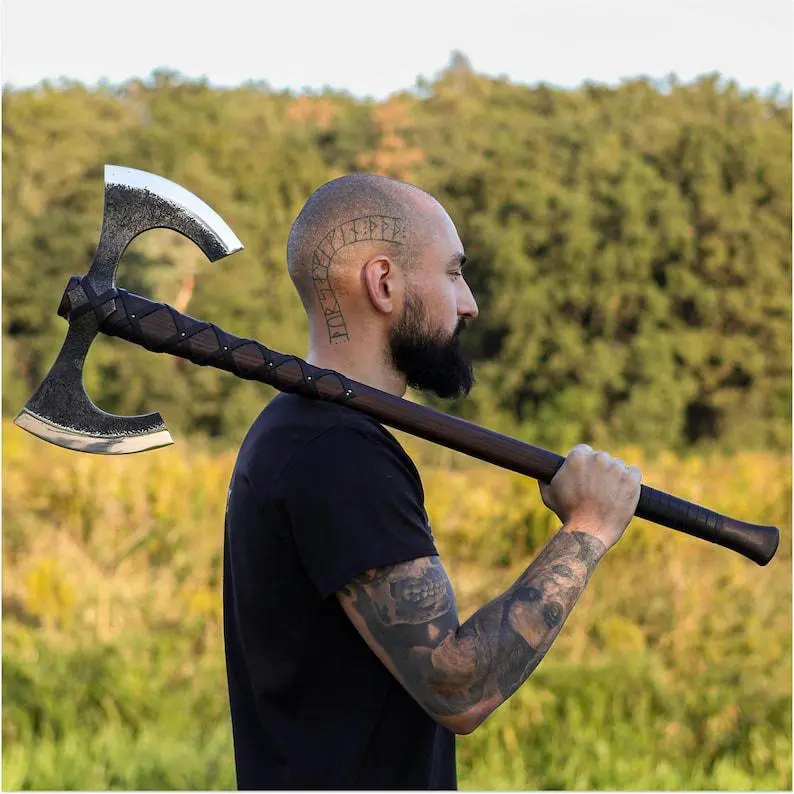
The most iconic Viking axe design. The blade features an extended lower cutting edge — the “beard” — that drops below the handle line, creating a longer edge without adding excess weight. Ideal for one-handed combat, versatile woodworking, and historical display.
Best for: collectors, HEMA beginners, display, reenactment
Typical head weight: 600–900g
👉 Shop Bearded Axes
Battle Axe
A broader, heavier blade designed purely for combat. Less refined than the bearded axe but devastating in impact. The wide cutting edge is designed to split shields and overwhelm armour. Often seen in two-handed configurations.
Best for: HEMA training, serious collectors, display
Typical head weight: 900g–1.5kg
👉 Shop Viking Battle Axes
Dane Axe
The largest of the Viking axe family. A long, swept blade mounted on a haft of 1.2–1.5 metres — this is a two-handed battlefield weapon. Historically used by elite huscarl warriors and depicted in the Bayeux Tapestry. A statement piece for serious collectors.
Best for: serious collectors, display, advanced HEMA
Typical head weight: 1–2kg
👉 Shop Dane Axes
Throwing Axe
Smaller, lighter, and symmetrically balanced for rotation in flight. Used by Viking skirmishers to disrupt enemy formations before a shield wall clash. Today popular in axe-throwing sport and competition.
Best for: axe throwing sport, outdoors, gifting
Typical head weight: 300–500g
👉 Shop Throwing Axes
Viking Hatchet
The everyday carry of the Norse world. Compact, light, and brutally practical — used for camp tasks, kindling, close-quarters backup, and travel. The most accessible entry point into Viking axe ownership.
Best for: outdoorsmen, gift buyers, first purchase
Typical head weight: 400–700g
👉 Shop Viking Hatchets
Step 3 — Understand Steel (This Is the Most Important Part)
Steel quality is where most cheap Viking axes fail. There are two types you will encounter, and the difference is significant.
High Carbon Steel — What You Want
High carbon steel (typically 1075 HC or 1080 HC) is the correct material for a real Viking axe. Here is why:
- Holds a sharp edge — you can sharpen it to a working blade and it stays sharp
- Can be re-sharpened — indefinitely, with the right stone or file
- Authentic — Norse blacksmiths worked exclusively with high carbon iron/steel alloys
- Develops a natural patina — the dark, aged look of a genuine working tool
- Battle-ready — withstands real impact without shattering or deforming
The trade-off: high carbon steel requires basic care. Wipe the blade dry after use and apply a thin coat of oil periodically to prevent surface rust. This is a 2-minute task, not a burden.
Stainless Steel — What to Avoid
Stainless steel looks attractive in product photos — bright, polished, rust-free. But for a functional axe it is the wrong choice:
- Cannot hold a working edge — too soft; the blade folds rather than holds under impact
- Cannot be properly sharpened — frustrating and ineffective
- Not authentic — no Viking weapon was ever made from stainless steel
- Shatters under stress — cheaper stainless alloys become brittle in cold temperatures
Stainless steel is acceptable only for decorative wall pieces that will never be handled. If there is any chance you will ever use, train with, or test your axe — buy high carbon steel.
Rule of thumb: if a seller does not specify the steel type, assume it is low-grade stainless and move on.
Step 4 — Evaluate the Blade
Beyond steel type, examine these four blade characteristics before buying.
Geometry and Profile
A historically accurate Viking axe blade is thin behind the edge — not wedge-shaped like a splitting maul. A thin grind cuts cleanly and efficiently. Many cheap axes use a thick, wedge grind that looks like an axe but performs like a club.
Edge Finish
A real battle-ready axe arrives with a working edge — meaning it is ground to a sharp, functional bevel. Some display axes ship unsharpened; this is acceptable for wall pieces but not for any functional use.
Forging Method
Hand-forged blades are worked by a blacksmith using hammer and anvil, which aligns the steel grain structure along the blade edge — making it stronger and tougher under impact.
Machine-stamped blades are punched from sheet steel. They are uniform and cheap to produce but lack the grain structure, character, and durability of a forged blade.
Look for “hand-forged” in the product description. If it is not mentioned, it is almost certainly stamped.
Finish and Patina
A quality axe will have either a clean grind finish or a natural blacksmith’s patina — the dark, slightly uneven surface that comes from the forging process. This is not a defect; it is authenticity. Avoid chrome-plated or heavily polished blades on axes marketed as “Viking” — these are costume props.
Step 5 — Choose the Right Handle (Haft)
The handle is half the weapon. A poor haft ruins an otherwise excellent axe head.
Wood Species
The best haft materials for a Viking axe are:
- Ash — traditional Norse choice; flexible, strong, light
- Hickory — harder than ash, excellent shock absorption
- Oak — heavy and dense; ideal for display and decorative pieces
Avoid synthetic handles, fiberglass, or unspecified “hardwood” — these are indicators of a budget product.
Length
Handle length determines whether the axe is one-handed or two-handed, and strongly affects balance and intended use:
| Use | Haft Length |
|---|---|
| One-handed combat / display | 50–70cm |
| Versatile / medium | 70–90cm |
| Two-handed / Dane Axe | 100–150cm |
| Throwing axe | 35–50cm |
For most buyers — especially first-time buyers — a 60–75cm haft is the most versatile. It can be used one-handed comfortably, gives good leverage for light chopping, and looks proportionally correct for wall display.
Fit and Security
The axe head should be fitted onto the haft with a tight wedge — traditionally a wooden or metal wedge driven into the top of the handle inside the eye of the axe head. Test any axe you handle: there should be zero wobble. A loose head is dangerous and a sign of poor assembly.
Step 6 — Red Flags to Avoid When Buying
Here is a quick checklist of what to walk away from:
- ❌ No steel type specified
- ❌ “Stainless steel” on a functional axe
- ❌ Machine-stamped, not forged
- ❌ Chrome or mirror polish on a “Viking” axe
- ❌ Plastic or resin handle
- ❌ Under $30 — genuine hand-forged high carbon axes cannot be produced at this price point
- ❌ No returns or quality guarantee
- ❌ Generic stock photos with no real product images
What Makes an Axe “Authentic”?
The phrase authentic viking axe means different things to different buyers. Here is a useful framework:
Historically accurate means the blade shape, dimensions, and construction method closely match archaeological examples from the Viking Age (793–1066 AD). This includes correct blade geometry, hand-forged construction, and a period-appropriate haft.
Battle-ready means the axe is built to withstand real use — it will not break, deform, or dull immediately under impact. High carbon steel, proper forging, and a tight haft fit are the markers.
Aesthetically authentic means it looks like a genuine Norse weapon — dark forged finish, correct proportions, no modern additions like chrome plating or branded engravings.
The best axes hit all three. At Orion Krafts, every axe in the collection is hand-forged in high carbon steel and built to historical specifications — whether you are buying for your wall, your training hall, or your collection.
👉 Browse the full Viking Axe collection — real, battle-ready, hand-forged
Quick Buyer’s Reference
| Buyer Type | Best Axe | Steel | Haft Length |
|---|---|---|---|
| Display / collector | Bearded Axe or Dane Axe | High carbon | 60–75cm |
| HEMA / training | Battle Axe or Bearded Axe | 1075 / 1080 HC | 60–80cm |
| Outdoors / bushcraft | Viking Hatchet or Bearded Axe | High carbon | 50–70cm |
| Axe throwing | Throwing Axe | High carbon | 35–50cm |
| Gift buyer | Bearded Axe | High carbon | 60–75cm |
Frequently Asked Questions
What is the best viking axe to buy for a first-time buyer?
The bearded axe is the ideal first purchase — it is the most historically accurate, the most versatile, and the most visually striking. Choose one in 1075 high carbon steel with an ash or hickory handle in the 60–75cm range.
How much should I spend on a real viking axe?
A genuine hand-forged high carbon steel Viking axe starts from around $60–$80 for a hatchet or light bearded axe, up to $150–$300+ for a full battle axe or Dane Axe with a decorated finish. If a “Viking axe” is listed under $30, it is not hand-forged and almost certainly not high carbon steel.
Can I use a Viking axe for woodchopping?
Yes — particularly the bearded axe and Viking hatchet. The thin blade geometry and high carbon edge handle wood splitting and carving well. Avoid using a display-finish or engraved axe for heavy outdoor use.
Is a battle axe the same as a Viking axe?
A battle axe is a broad category of combat axes. Viking axes — bearded, Dane, and battle axes — are specific designs from the Norse tradition. Not all battle axes are Viking axes, but all Viking combat axes are a type of battle axe.
Are viking axes legal to own?
In most countries, yes — owning a Viking axe as a tool, collector’s item, or historical reproduction is entirely legal. Check your local laws if you intend to carry one in public.
Conclusion
A real Viking axe is not just a purchase — it is an investment in craftsmanship, history, and a weapon tradition that lasted centuries. The difference between a great axe and a disappointing one comes down to four things: the right type for your purpose, high carbon steel, hand-forged construction, and a quality haft.
Get those four things right and you will own a piece that lasts a lifetime.
👉 Shop real, hand-forged Viking axes at Orion Krafts →
Related Reading:

Add comment