
What Is a Bearded Axe? History, Design & Uses
Introduction
If you have ever seen a Viking axe with that distinctive downward-hooked blade, you have already seen a bearded axe. It is one of the most recognisable weapons in Norse history — and one of the most misunderstood.
The bearded axe was not just a weapon. It was a tool, a status symbol, and an engineering achievement centuries ahead of its time. Whether you are a history enthusiast, a collector, or someone looking to own a piece of Norse heritage, understanding the bearded axe means understanding the Vikings themselves.
In this guide we cover everything you need to know: what a bearded axe is, where the “beard” name comes from, why Norse warriors designed it that way, and how it was used in battle and daily life.
What Is a Bearded Axe?
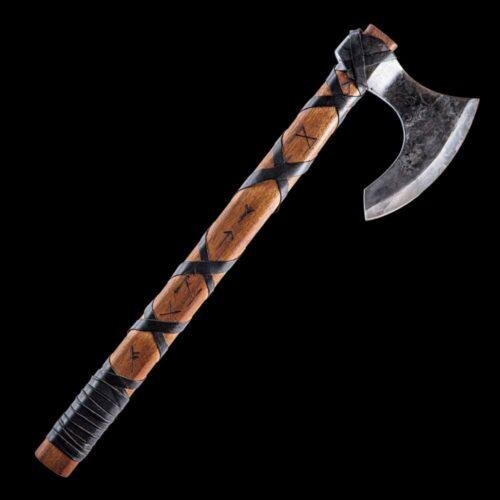
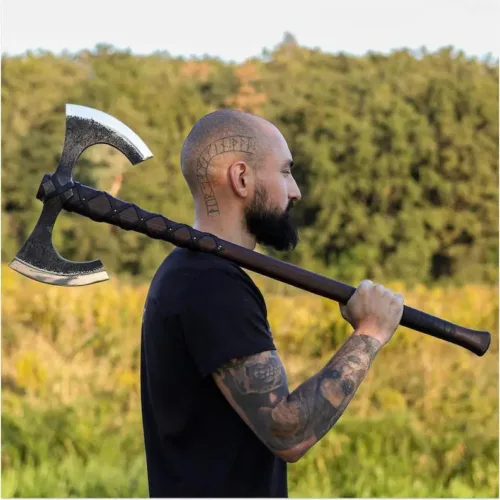
A bearded axe — known in Old Norse as a skeggøx (literally “beard axe”) — is a type of axe characterised by a blade with an extended lower cutting edge that hooks downward below the handle line. This elongated lower portion of the blade is called the beard, which is where both the weapon and the nickname “axe and beard” come from.
The beard creates a longer cutting edge without adding unnecessary weight to the top of the axe head. This distinction separates the bearded axe from a standard axe, where the blade and handle align on a straight horizontal plane.
Key identifying features of a bearded axe:
- Extended lower cutting edge curving downward (the “beard”)
- Thin, wide blade — often less than 400g for the head alone
- Long cutting edge relative to axe weight
- Hook at the lower corner of the blade
- Typically mounted on a long wooden haft (handle)
The History of the Bearded Axe
Origins: Before the Vikings
The bearded axe did not originate with the Vikings. Archaeological evidence traces the design back to at least the 6th century AD across Scandinavia and parts of Northern Europe. However, it was the Norse peoples of the Viking Age (793–1066 AD) who perfected, popularised, and weaponised the design in ways that left a permanent mark on history.
Early forms of the bearded axe appeared as agricultural and woodworking tools. The hooked lower blade was practical for carving, notching wood, and working around tight spaces — the beard allowed a craftsman to take precise cuts without the full axe weight bearing down at an awkward angle.
The Viking Age Bearded Axe
By the 8th and 9th centuries, Norse blacksmiths had evolved the bearded axe into a devastating combat weapon. Viking raiders and warriors carried the skeggøx as both a primary weapon and a close-quarters tool for ship-boarding, siege, and field combat.
Archaeological finds across Scandinavia, England, Ireland, and Russia confirm the widespread use of bearded axes throughout the Viking Age. The most famous example is the Mammen Axe, discovered in a 10th-century Danish burial, decorated with intricate inlaid silver — proof that the bearded axe was also a prestige object carried by high-status warriors and chieftains.
The Dane Axe — The Bearded Axe’s Larger Cousin
By the late Viking Age (10th–11th century), a larger variant emerged: the Dane Axe. With an even longer cutting edge and a haft sometimes exceeding 1.5 metres, the Dane Axe was a two-handed weapon designed to cut through shields and armour in open-field battle. It features the same bearded design philosophy taken to its most extreme form.
The famous Bayeux Tapestry (1070s) depicts both Viking and English huscarl warriors wielding Dane Axes at the Battle of Hastings in 1066 — one of the most detailed historical records of Norse axe combat ever made.
Why Was It Called the “Axe and Beard”?
The connection between the weapon and a beard is purely visual — and once you see it, you cannot unsee it.
Look at a bearded axe from the side. The upper edge of the blade runs roughly horizontal, while the lower edge drops sharply downward in a long curve. The result is a shape that mirrors a human chin and beard: a flat upper jaw and a long, downward-sweeping beard below.
Old Norse speakers called it a skeggøx — skegg meaning beard. The English phrase “axe and beard” is a direct translation of that same concept.
Today, the term “axe and beard” is still commonly searched by people who have seen the distinctive design and are looking to find out what it is. It is also the name adopted by a number of modern Viking-style axe brands, tattoo designs, and woodworking communities.
The Design: Why the Beard Shape?
The bearded axe is not just aesthetic — every element of its design solves a specific problem.
1. Longer Cutting Edge, Less Weight
By extending the blade downward rather than widening it upward, Norse smiths created a longer cutting edge without adding mass at the top of the head. This kept the axe balanced, fast, and light enough to wield one-handed for extended periods.
2. Grip Below the Head
The beard creates a natural finger guard. A warrior could “choke up” on the handle, gripping the haft just below the axe head for close-quarters control — something impossible with a standard axe where the blade flares symmetrically.
3. Hooking and Trapping
In combat, the hook at the bottom of the beard could be used to pull an opponent’s shield downward, hook behind a leg, or trap an enemy’s weapon. This made the bearded axe a highly versatile tool in experienced hands.
4. Versatility as a Tool
Outside of battle, the beard shape was exceptional for woodworking — particularly for making ships. Norse shipbuilders used bearded axes to shape planks and hull timbers with a level of precision rarely achieved by other tools of the era.
How Vikings Used the Bearded Axe in Battle
Viking combat was fast, brutal, and pragmatic. The bearded axe suited this style perfectly.
One-handed use with a shield: Most Viking warriors carried the bearded axe in one hand and a round shield in the other. The light head and long cutting edge allowed powerful horizontal swings, overhead strikes, and fast recovery without overextending.
Shield hooking: The beard’s lower hook was used to catch the rim of an opponent’s shield and yank it down, exposing the body for a follow-up strike.
Throwing: Some lighter bearded axes were thrown at enemy lines before a shield wall clash — a tactic recorded in several Norse sagas and corroborated by finds of lighter axe designs.
Two-handed strikes: When a warrior dropped his shield — either by choice or necessity — a bearded axe wielded two-handed delivered devastating chopping blows capable of breaking through leather armour and splitting wooden shields.
Bearded Axe vs. Other Viking Axes
| Axe Type | Blade Style | Best For | Typical Use |
|---|---|---|---|
| Bearded Axe | Hooked lower beard | Versatility — combat + tools | Warrior / craftsman |
| Dane Axe | Wide, swept edge | Two-handed battlefield use | Heavy infantry |
| Throwing Axe | Small, symmetric | Ranged attack | Skirmisher |
| Viking Hatchet | Short, compact | Camp tool / close quarters | Every warrior |
Bearded Axes in Norse Culture
Beyond the battlefield, the bearded axe held deep cultural significance in Norse society.
Symbol of status: Elaborately decorated axes like the Mammen Axe were buried with wealthy warriors. The quality of a man’s axe signalled his rank and wealth.
Odin’s weapon: While Odin is primarily associated with the spear Gungnir, axes feature prominently in Norse mythological art and carvings as symbols of divine power and war.
Legal significance: In Norse law, a man’s weapons — including his axe — were personal property that could not be seized by creditors, reflecting how central the axe was to Viking identity.
Everyday tool: For the average Norse farmer or shipbuilder, the bearded axe was simply the most practical cutting tool available. Its dual role as weapon and work tool made it the Swiss Army knife of the Viking Age.
What to Look for in an Authentic Bearded Axe Today
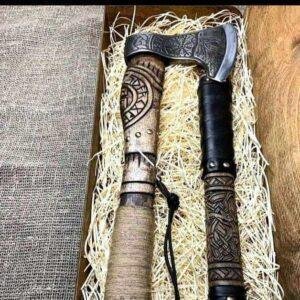
If you are looking to own a genuine bearded axe — whether for display, HEMA training, reenactment, or collection — here is what separates a quality piece from a cheap reproduction:
- High carbon steel blade (1075 or 1080 HC steel) — holds an edge and can be resharpened
- Hand-forged construction — machine-stamped blades lack the grain structure and authenticity of forged axes
- Correct beard geometry — the lower hook should be pronounced and functional, not decorative
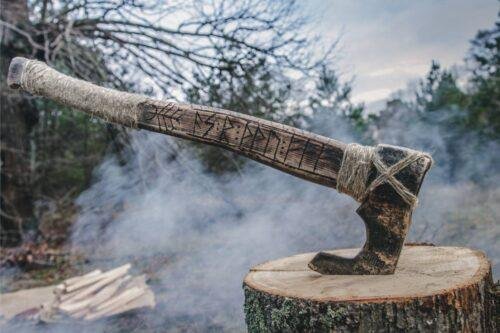
- Hardwood haft — ash, hickory, or oak; period-accurate length (typically 60–80cm for one-handed use)
- Proper weight balance — a battle-ready bearded axe head should feel front-weighted but controllable, typically 600–900g
👉 Browse our collection of authentic Viking bearded axes — hand-forged, battle-ready, and built to historical specifications.
Frequently Asked Questions
What is the difference between a bearded axe and a regular axe?
A regular axe has a blade that sits symmetrically around the handle line. A bearded axe has an extended lower cutting edge — the “beard” — that drops below the handle, creating a longer edge without added top weight.
Is a bearded axe a good choice for a real axe?
Yes. The bearded axe design is highly functional. The long cutting edge, light head weight, and beard hook make it excellent for both combat applications and woodworking or general use.
What did Vikings call the bearded axe?
The Old Norse name is skeggøx — from skegg (beard) and øx (axe).
How heavy is a Viking bearded axe?
Historically, bearded axe heads weighed between 400g and 900g, depending on the type. Combat axes tended toward the lighter end for speed; heavier versions were used for woodwork and heavy chopping.
Can I buy a battle-ready bearded axe?
Yes — our bearded axe collection features hand-forged, high carbon steel axes built to historical specifications, suitable for display, reenactment, and HEMA training.
Conclusion
The bearded axe is one of the most elegant weapon designs in human history. Its distinctive shape — practical, balanced, and immediately recognisable — is a direct product of Viking ingenuity. More than a thousand years after Norse warriors first carried it into battle, the bearded axe remains one of the most sought-after pieces of Norse heritage in the world.
Whether you are drawn to the history, the craftsmanship, or the sheer visual power of the design, owning a quality bearded axe is owning a piece of the Viking Age.

Add comment