
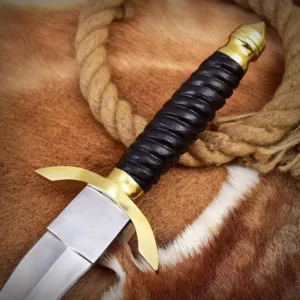
History of Viking Knives: Origins, Craftsmanship & Norse Blade Traditions
Introduction: Why Viking Knives Matter
When most people think of Viking weapons, they picture longships, battle axes, and broadswords. But the most essential tool carried by every Norse man, woman, and warrior was far more modest — the Viking knife. Whether used for eating, crafting, hunting, or combat, Viking knives were inseparable from daily Norse life.
Understanding the history of Viking knives means stepping into the world of Iron Age Scandinavia, where skilled blacksmiths forged blades that balanced beauty with brutal functionality. These ancient Norse blades are not just historical artifacts — they are the direct ancestors of many of today’s most prized handmade knives, bushcraft blades, and collector pieces.
This article explores the full history of Viking knives: their origins, types, craftsmanship methods, cultural significance, and enduring legacy in the modern world.
⚔️ Own a Piece of Viking History
Inspired by authentic Norse blade traditions, our handcrafted Viking knives are forged for collectors, adventurers, and history enthusiasts alike.
The Origins of Viking Knives: Iron Age Scandinavia (500 BC – 793 AD)
From Bronze to Iron: The Technological Shift
Long before the Viking Age officially began, Scandinavian craftsmen were already developing advanced bladesmithing traditions. The transition from the Bronze Age to the Iron Age around 500 BC was a turning point in Norse knife history. Iron was harder, more abundant, and more versatile than bronze — making it ideal for producing sharp, durable blades.
Early Norse knives from this period were simple in form: single-edged blades with organic handles made from wood, antler, or bone. Archaeological digs across Norway, Sweden, Denmark, and Finland have uncovered thousands of these early knives, revealing a culture that depended on bladed tools for survival.
Pre-Viking Scandinavian Knife Traditions
Even before the Viking Age (which historians conventionally date from 793 AD), Scandinavian peoples carried small utility knives as everyday tools. These knives were personal possessions — carried on the body at all times, much like a modern pocket knife. They were used for:
- Preparing and eating food
- Carving wood and bone
- Skinning and processing animals
- Leatherworking and rope cutting
- Basic self-defense
This deep cultural relationship with the knife laid the groundwork for the iconic blade traditions of the Viking Age.
The Viking Age and the Rise of Norse Knife Culture (793 – 1066 AD)
What Was the Viking Age?
The Viking Age is traditionally dated from the raid on Lindisfarne Monastery in 793 AD to the Norman Conquest of England in 1066 AD. During this roughly 300-year period, Norse seafarers — traders, explorers, and raiders — spread across Europe, Asia, and even North America, carrying their material culture, including their distinctive knives, wherever they went.
Every Viking Carried a Knife
One of the most important facts about Viking knife history is that blade-carrying was universal in Norse society — not just among warriors. Farmers, fishermen, merchants, women, and children all carried knives. Archaeological evidence from burial sites across Scandinavia consistently shows knives as among the most commonly interred personal items.
This was not unusual in a pre-industrial world without stores or restaurants. A Viking knife was as essential as a smartphone is today: a multi-purpose tool that a person rarely left home without.
Types of Viking Knives: The Key Norse Blade Designs
1. The Seax (Scramasax) — The Iconic Viking Knife
The seax (also spelled sax or scramasax) is the most historically significant and recognizable Viking knife. The word “seax” is Old English/Old Norse for “knife” or “short sword,” and it gave the name to the Saxon people of England.
Key characteristics of the seax:
- Single-edged blade, typically 15–75 cm in length
- Clipped point (the spine drops sharply near the tip)
- Flat grind with a deep fuller (blood groove)
- Handles of wood, antler, horn, or bone
- Worn horizontally at the front of the belt in a leather sheath
Seaxes existed on a spectrum from small everyday utility knives to large combat weapons. Archaeologists classify them as:
- Small seax – a personal utility knife (similar to a modern EDC blade)
- Long seax – a sidearm weapon, roughly the size of a short sword
- Breaking-back seax – identified by the distinctive angled spine drop toward the tip
The seax was so culturally important that in many parts of Northern Europe, free men were legally required to carry one as a symbol of their status.
2. The Kniv (Utility Knife)
Beyond the seax, Norse people carried smaller general-purpose knives known simply as kniv (the root of the modern English word “knife”). These were:
- Short blades (7–15 cm)
- Used daily for food preparation, crafting, and repair
- Often carried in simple leather sheaths on a belt
- Found in the graves of men, women, and children alike
These Viking utility knives closely resemble what we today call Scandinavian knives or Scandi-grind knives — a blade geometry still celebrated for its simplicity and cutting performance.
3. Viking Combat Knives
While most Viking knives were tools first, larger combat-oriented blades also existed. Some Viking warriors carried dedicated fighting knives as backup weapons alongside their swords and axes. These featured:
- Longer, heavier blades (25–60 cm)
- More robust construction to withstand combat stress
- Sometimes double-edged toward the tip for thrusting
- Richer decorative elements indicating the owner’s high status
Historical sagas and poetry frequently mention knife combat in close-quarters fighting, suggesting these blades were serious weapons, not merely ornamental.
4. Decorative and Ceremonial Viking Knives
High-status Vikings — jarls, chieftains, and wealthy merchants — carried knives adorned with intricate Norse craftsmanship. These ceremonial or prestige knives featured:
- Handles inlaid with silver, bronze, or gold
- Engraved Norse knotwork, Vegvísir (Viking compass), or runic inscriptions
- Patterned (Damascus-style) blades from pattern-welded iron
- Elaborate sheaths decorated with leather tooling or metal fittings
These Viking knives were symbols of wealth, power, and Norse cultural identity — heirlooms passed down through generations.
🔪 Find Your Perfect Viking Knife
From seax-style blades to handcrafted Norse utility knives — explore our full collection of premium Viking knives, each forged with traditional craftsmanship.
Viking Knife Construction: How Norse Blacksmiths Forged Blades
The Norse Blacksmith: A Sacred Craftsman
In Norse mythology, the art of smithing was divinely connected. Dwarves (dvergar) were the master craftsmen of the mythological realm, forging legendary weapons for the gods. Real-world Norse blacksmiths (smíðr) carried enormous social prestige. Their craft was considered both a technical skill and a spiritual practice.
Viking blade-making required years of apprenticeship. The knowledge was passed down through family workshops across generations.
Raw Materials: Iron and Steel in Viking Age Scandinavia
Viking-Age Norse smiths worked primarily with:
- Bog iron – iron extracted from peat bogs and lake beds throughout Scandinavia. Bog iron was plentiful but variable in quality.
- Imported steel – higher-quality iron and early steel was traded from the Frankish kingdoms and the Islamic world.
The quality of blade iron varied enormously. Skilled smiths learned to select, sort, and process raw iron into usable blade steel through repeated heating and hammering — a process called consolidation.
Forging Techniques: Pattern Welding and Differential Hardening
Viking blacksmiths used two key techniques that still influence modern knife making:
1. Pattern Welding (Proto-Damascus) Some of the most prized Norse blades were made using pattern welding — twisting and forge-welding multiple bars of iron with different carbon contents together. When etched, these blades reveal beautiful flowing patterns in the steel, similar to modern Damascus steel. Pattern welding also created blades with a strong, flexible core and harder cutting edges.
2. Differential Hardening Viking smiths understood that carbon content affected hardness. They learned to selectively carburize (add carbon to) the cutting edge while keeping the spine softer and more flexible — creating blades that held a sharp edge but resisted breaking. This is essentially the same principle used by Japanese sword makers.
Blade Geometry: The Scandinavian Grind
A defining feature of traditional Viking knives is the Scandi grind (Scandinavian grind) — a flat, wide bevel that runs from the spine to the edge with no secondary bevel. This geometry:
- Creates an extremely sharp, durable edge
- Is easy to sharpen in the field with a flat stone
- Provides excellent control during push cuts and carving
- Has excellent wood-carving performance
The Scandi grind is still considered one of the best blade geometries for bushcraft, survival, and utility knives. It is the direct descendant of Viking knife-making tradition.
Handle Materials and Construction
Viking knife handles were made from whatever organic material was available locally:
- Wood – most common; birch, ash, yew, and maple were favored
- Antler – widely used, durable, and naturally grippy
- Bone – carved animal bones, often decorated
- Horn – cattle and elk horn, polished smooth
High-status handles incorporated precious materials like walrus ivory, amber, or decorated metal fittings. Handles were typically pinned or riveted to the tang — a construction method still used in high-quality hand-forged knives today.
Viking Knife Sheaths: Function and Art
The Viking knife sheath (slíðr) was as important as the blade itself. Sheaths were:
- Made from vegetable-tanned leather, formed wet around the blade
- Often decorated with carved or stamped geometric patterns, knotwork, and animal motifs
- Fitted with bronze, iron, or silver throat and tip reinforcements
- Suspended from the belt horizontally (for seaxes) or vertically (for smaller knives)
Archaeological examples recovered from sites across Scandinavia, England, and Russia show tremendous variety and craftsmanship in Viking knife sheaths. Some feature stunning tooled leather artwork that has survived over a thousand years.
Viking Knives in Norse Culture and Society
Knives in Norse Mythology and Symbolism
Blades carried deep symbolic weight in Norse culture. The act of giving a knife was laden with meaning — in some traditions, receiving a knife as a gift required giving a small coin in return, to avoid “cutting” the friendship or bond between giver and receiver.
The knife was associated with:
- Odin – the Allfather’s wisdom, sacrifice, and the power to cut through deception
- Freyr – fertility, harvest, and the knife’s role in the slaughter of animals for food and offering
- The Norns – the Norse Fates were said to cut the threads of destiny, linking blades to fate and death
Runic inscriptions on knife blades and handles are found in archaeological collections, suggesting blades were sometimes enchanted or dedicated to specific purposes.
Rites of Passage and Viking Knives
In Norse society, receiving a first knife was a significant rite of passage. Young men were gifted their first proper knife when they were deemed old enough to carry responsibility — similar to how a first hunting rifle or pocket knife marks adulthood in many modern cultures.
For Viking warriors, a knife was the last line of defense: if a warrior lost their sword and axe in battle, the knife remained. Norse sagas describe warriors fighting to the death with their knives when all other weapons were gone.
Women and Viking Knives
Viking women also carried knives, and archaeological evidence proves it. Women’s graves throughout Scandinavia regularly contain small utility knives. Norse women used their knives for:
- Food preparation and cooking
- Textile work (cutting thread, trimming leather)
- Household crafts
- Personal protection
The image of the knife as a “man’s weapon” does not apply to Viking culture, where blade-carrying was universal across gender lines.
Famous Viking Knife Finds: Archaeological Treasures
The Repton Seax
Found at a Viking camp site in Repton, Derbyshire, England — one of the best-preserved seaxes ever discovered. Dating to the 9th century, it demonstrates the high skill of Viking-Age bladesmiths operating in England during the Great Heathen Army’s campaign.
The Hedeby Finds
Hedeby (Haithabu), the great Viking trading town in modern-day Germany, yielded a remarkable collection of Norse knives during archaeological excavations. These knives show the range of Viking blade types — from simple utility knives to finely decorated prestige blades — and reflect the cosmopolitan, trade-oriented nature of Viking society.
The York Viking Knives (Jorvik)
The Coppergate excavations in York, England — site of the Viking city of Jorvik — produced numerous Viking-Age knives in excellent preservation conditions. These finds provide detailed information about construction methods, handle materials, and the everyday use of Norse blades in an urban Viking settlement.
The Mammen Find
The Mammen burial in Denmark (10th century) is famous for its extraordinarily rich Viking grave goods, including decorated iron and silver objects. Blade artifacts from Mammen-style finds show the height of Viking artistic achievement applied to weaponry and tools.
After the Viking Age: The Legacy of Norse Knife Traditions
The End of the Viking Age (1066 AD)
The conventional end of the Viking Age — the Norman Conquest of England in 1066 — did not mark the end of Norse knife traditions. The bladesmithing knowledge developed over centuries in Scandinavia continued evolving. Viking knife design gradually influenced the knives of medieval Europe, and Scandinavian blade culture retained its distinctive character.
The Puukko: The Living Descendant of the Viking Knife
The Finnish puukko knife is perhaps the most direct living descendant of the Viking knife. The puukko shares almost every characteristic with its Norse ancestors:
- Single-edged short blade
- Scandi grind geometry
- Organic handle (typically wood or reindeer antler)
- Simple leather sheath
Puukko knives are still made by hand in Finland today, continuing a blade tradition with roots in the Viking Age and beyond.
The Scandinavian Knife Tradition Today
Countries across Scandinavia maintain living knife-making traditions directly descended from Viking Age craftsmanship:
- Sweden – the mora knife (Mora of Sweden) brings Scandi grind blade geometry to mass production
- Norway – traditional Norwegian knives (tollekniv) preserve Viking handle and blade proportions
- Denmark – knife making guilds in Copenhagen trace roots back to medieval craftsmen trained in Viking traditions
Viking Knives in the Modern World
The Revival of Viking Knife Collecting and Craft
In recent decades, there has been a global revival of interest in authentic Viking knives. This trend is driven by:
- Historical reenactors and Living History groups – who require period-accurate Norse blades
- Bushcraft and survival enthusiasts – who prize the practical performance of Scandi-grind blades
- Collectors of historical weapons – who seek museum-quality replicas and originals
- Norse heritage enthusiasts – inspired by the culture, mythology, and craftsmanship of the Viking Age
What Makes a Knife a “Viking Knife” Today?
Modern Viking knives typically draw inspiration from historical Norse design in one or more of these ways:
- Seax-style blade geometry – clipped point, single edge, fuller
- Scandi grind – the flat bevel inherited from Viking bladesmithing
- Natural handle materials – wood, antler, bone, or horn
- Norse decorative elements – knotwork, Vegvísir, runic inscriptions, or Mammen-style animal art
- Hand-forged construction – using traditional smithing methods including pattern welding
The Best Viking Knife Materials Today
Modern Viking knife makers combine historical design with contemporary materials science:
- High-carbon steel (1075, 1084, W2) – mirrors the carbon-rich edges of historical Norse blades
- Damascus / pattern-welded steel – directly inspired by Viking pattern-welding techniques
- Stainless steel (14C28N, VG-10) – modern convenience while maintaining Scandi geometry
- Natural handle materials – stabilized wood, genuine antler, micarta (for durability)
How to Choose a Viking Knife: Buyer’s Guide
Whether you’re a collector, reenactor, outdoor enthusiast, or simply drawn to Norse aesthetics, choosing a Viking knife involves several key considerations:
Blade Length: Utility Viking knives typically range from 10–20 cm. Seax-style fighting knives can reach 30–60 cm.
Steel Type: High-carbon steel offers superior edge retention and is closer to historical authenticity. Stainless is easier to maintain.
Grind: Look for a true Scandi grind for authentic Viking knife performance and easy field sharpening.
Handle: Full tang construction with natural materials (wood, antler, bone) is most historically accurate.
Sheath: A hand-stitched leather sheath with period-appropriate construction completes the authentic Viking knife package.
🛡️ Ready to Choose Your Viking Knife?
At Orion Krafts, every knife is hand-forged using traditional methods — full tang construction, natural handle materials, and blades built to last a lifetime (and beyond).
Conclusion: The Enduring Legacy of Viking Knives
The history of Viking knives is the history of Norse civilization itself — practical, beautiful, deeply crafted, and built to last. From the Iron Age bogs of Scandinavia to the bustling trading towns of the Viking Age, from the graves of Norse warriors to the workshops of modern bladesmiths, the Viking knife has traveled a remarkable journey across more than two thousand years.
What makes Viking knives so enduringly compelling is their perfect fusion of form and function. Norse bladesmiths did not separate art from utility — every cut line, every handle curve, every decorative element served both an aesthetic and a practical purpose. That philosophy still resonates today, which is why Viking knives remain among the most sought-after blades in the world.
Whether you carry a Viking knife for its history, its beauty, or its performance, you are connecting with one of the oldest and most sophisticated blade traditions in human history.
Frequently Asked Questions About Viking Knives
What is the most famous type of Viking knife? The seax (scramasax) is the most historically significant and iconic Viking knife. It was carried by virtually all Norse people and came in sizes ranging from a small utility knife to a large combat blade.
Did Vikings use Damascus steel? Viking smiths used a technique called pattern welding, which is the historical precursor to what we today call Damascus steel. While not identical to Middle Eastern wootz Damascus, Viking pattern-welded blades share the same principle of layering and welding different iron compositions for beautiful and functional results.
What is a Scandi grind? A Scandi grind (Scandinavian grind) is a blade geometry where a single wide bevel runs from the spine to the cutting edge with no secondary bevel. It is the traditional grind of Viking knives and their descendants, prized for sharpness, durability, and ease of sharpening.
Were Viking knives only used as weapons? No — the vast majority of Viking knives were everyday utility tools used for eating, cooking, woodworking, leatherworking, and crafting. Large combat seaxes existed, but most Norse knives were practical tools, not weapons.
What materials were Viking knife handles made from? Viking knife handles were most commonly made from wood (birch, ash, maple), antler, bone, and horn. High-status blades featured handles with silver, bronze, or gold inlay, and some used walrus ivory or amber.

Add comment