
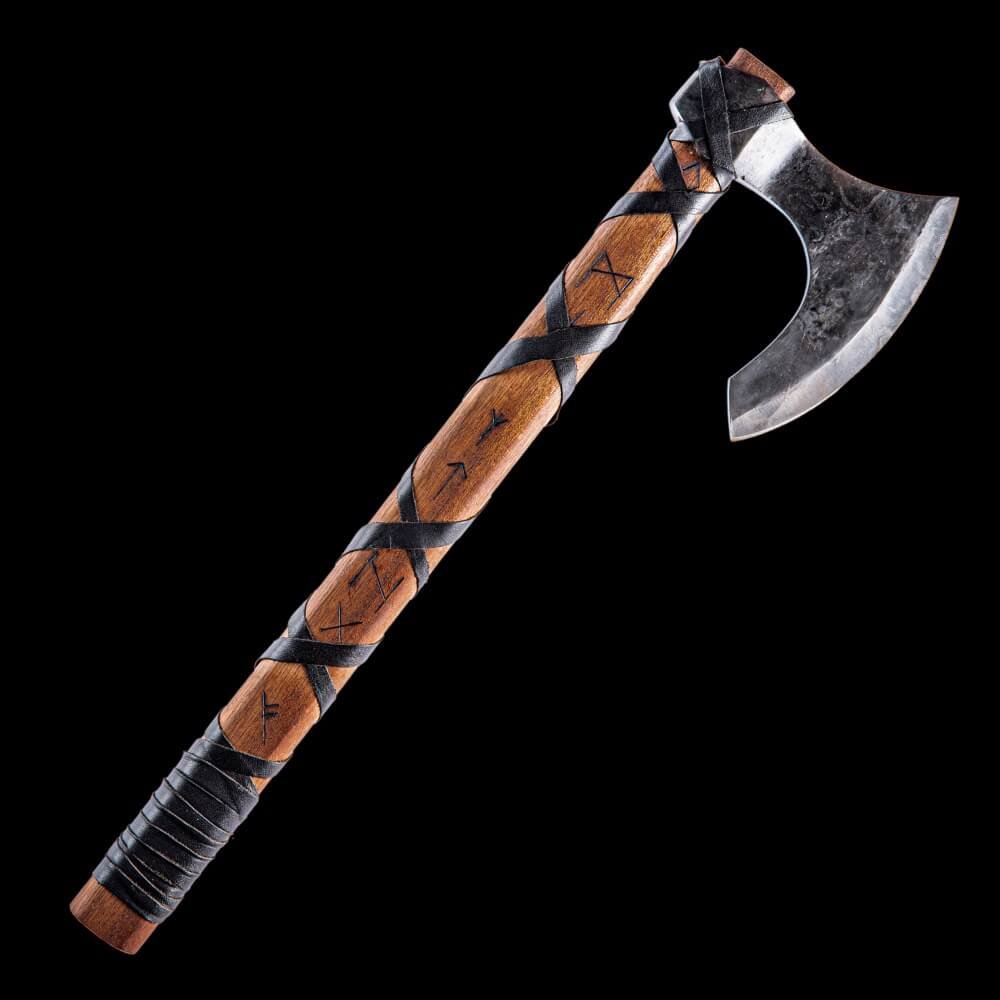
Viking Axe History: The Brutal Weapons of Norse Warriors
Introduction
In the summer of 793 AD, Norse longships appeared off the coast of Lindisfarne, a small island monastery on the northeast coast of England. What followed — the sacking of the monastery, the killing of monks, the looting of gold and silver — sent shockwaves across Christian Europe and announced the beginning of the Viking Age.
At the heart of that raid, and nearly every Norse engagement that followed for the next three centuries, was the axe.
Not the sword. Not the spear. The axe.
The Viking war axe is one of the most historically significant edged weapons ever produced — not because of its elegance, but because of its brutal effectiveness in the hands of warriors who had trained with it from childhood. Understanding how Vikings fought with the axe means understanding why Norse raiders were so feared, so successful, and so difficult to stop.
This is that history.
👉 Own a piece of it — shop authentic Viking axes at Orion Krafts
The Viking Age: A Brief Timeline
Before examining axe combat specifically, it helps to understand the historical window we are talking about.
The Viking Age spans roughly 793 to 1066 AD — from the raid on Lindisfarne to the Battle of Hastings, where Viking-descended Norman forces under William the Conqueror defeated the Anglo-Saxon King Harold, himself armed with a Dane Axe.
Three centuries of raiding, trading, exploration, and conquest. Norse warriors ranged from Newfoundland in the west to Constantinople in the east, from the Arctic north to the Mediterranean south. In every theatre of operation, the axe was present.
Who Were the Viking Warriors?
The term “Viking” is often used loosely to describe all Norsemen of the era. Historically, a vikingr referred specifically to a raider — a man who went on a raid (a viking) — rather than all Scandinavian people. But Viking Age Scandinavian society produced several distinct classes of warrior worth understanding.
The Bondi (Free Farmers)
The majority of Norse men who participated in raids were bondi — free farmers and landowners who took up arms seasonally. They provided their own weapons, trained with neighbours and kinsmen, and returned home after a campaign to tend their land. Most carried an axe as their primary weapon because it was affordable, familiar, and lethal.
The Hirðmen (Household Warriors)
A jarl or king’s personal retinue of professional warriors — full-time fighters who owed personal loyalty to their lord. Better armed and equipped than the bondi, the hirðmen were the core of a Norse fighting force. Many carried fine-quality bearded axes or battle axes alongside shields and seaxes.
The Huscarls (Elite Warriors)
The apex of Viking military society. Huscarls were professional household warriors employed by the wealthiest Norse kings and earls — essentially a standing army. They trained constantly, carried the best weapons including the devastating Dane Axe, and formed the front ranks of any major engagement.
The Berserkers (Úlfhéðnar and Berserkir)
Norse sagas describe a class of warrior who fought in a state of frenzied battle rage — the berserkers. Whether the berserker state was psychological, drug-induced, or ritualistic is still debated by historians. What is consistent across accounts is that they favoured heavy axes and fought without fear of injury, making them terrifying shock troops at the opening of a battle.
The Viking War Axe: Design for Combat
The Norse did not use the same axe they split firewood with as their primary combat weapon — at least, not the high-status warriors. The viking fighting axe was purpose-engineered for the specific demands of Norse combat.
Thin Blade Geometry
A Viking war axe blade is dramatically thinner than a splitting axe or woodchopping axe. Where a firewood axe needs a thick wedge to split fibres apart, a war axe needs to cut cleanly through flesh, leather armour, and wooden shields in a single stroke. Viking blacksmiths ground their war axe blades to a thin, convex edge that sliced rather than split.
Weight Forward, Light Overall
Norse war axes are surprisingly light by modern expectations. A typical bearded axe head weighed between 600 and 900 grams — less than a kilogram. This kept the weapon fast enough to recover between strikes, light enough to use for an extended fight without arm fatigue, and balanced enough to be thrown when necessary.
The weight was concentrated at the cutting edge rather than distributed evenly, creating momentum in a swing without requiring brute force to generate it.
The Long Cutting Edge
The bearded axe’s extended lower edge gave Norse warriors a cutting surface far longer than the head width would suggest. A blade with a 10cm socket width might carry a 20cm cutting edge — giving it slashing capability closer to a short sword than a traditional axe.
Steel Quality
The best Norse war axes were forged from high carbon steel — harder, more edge-retentive, and more durable than the wrought iron used in cheaper weapons. Elite warriors and high-status hirðmen carried axes with steel cutting edges forge-welded onto softer iron bodies — a sophisticated technique that combined toughness (the iron body absorbed impact shock) with hardness (the steel edge stayed sharp).
How Vikings Actually Fought: Combat Techniques
Popular depictions of Viking combat as frenzied, uncoordinated hacking bear little resemblance to how Norse warriors actually fought. Viking axe combat was disciplined, tactical, and built around a sophisticated understanding of leverage, timing, and geometry.
One-Handed Axe and Shield
The standard fighting configuration for most Viking warriors was axe in the right hand, round shield in the left. The round shield — typically 80–90cm in diameter, made from lime or fir wood with a central iron boss — was as much an offensive weapon as a defensive one.
In this configuration the axe was used for:
Overhead strikes — delivered from a high guard position, bringing the full weight of the axe down on a target’s head, shoulder, or weapon arm. The most powerful strike in the Norse arsenal.
Horizontal swings — fast, flat strikes targeting the neck, torso, and thigh. Designed to exploit gaps in an opponent’s guard rather than power through defences.
Thrusting with the butt — the iron butt cap (or simply the end of the haft) was used as a blunt striking tool in close range, where a full swing was impossible.
Hooking with the beard — the lower hook of a bearded axe caught an opponent’s shield rim and pulled it downward or to the side, breaking their guard and opening the body for a follow-up strike. This technique is described in several Norse sagas and is consistent with the design geometry of surviving axes.
Shield Wall Combat (Skjaldborg)
In large engagements — raids on fortified positions, pitched battles between competing Norse forces, or confrontations with English and Frankish armies — Vikings fought in a skjaldborg (shield wall).
Warriors stood shoulder to shoulder in a tight line, overlapping their shields to form a continuous defensive barrier. The front rank absorbed the initial impact of an enemy charge while the rear ranks pushed forward, maintaining pressure and feeding replacements to the front.
In the shield wall, the axe was used conservatively — short, controlled strikes over or around the shield line rather than wide swings that would expose the warrior to counterattack. The goal was to break the opponent’s shield wall by killing front-rankers, exploiting gaps, and forcing the line to fragment.
The Dane Axe in Open Battle
When the shield wall broke and battle became open-field melee, the huscarls with their Dane Axes came into their own.
A two-handed Dane Axe swung with full momentum could:
- Shatter a wooden shield in a single blow, rendering it useless
- Cut through the chain mail links of a haubergeon at close range
- Strike over or around an opponent’s guard due to the long haft reach
- Deflect or redirect incoming weapon strikes using the haft
The tactical role of the Dane Axe huscarls was similar to modern heavy infantry — they were used to break through fortified positions, destroy elite enemy units, and exploit gaps opened by lighter troops.
Axe Throwing
Before shield walls clashed, skirmishers on both sides would typically exchange missile fire — arrows, javelins, and in the Norse case, throwing axes.
A light Norse throwing axe, hurled at close range (10–20 metres) into a massed formation, did not need to kill to be effective. The rotation of an axe in flight made it unpredictable and difficult to deflect with a shield. A volley of throwing axes forced enemy warriors to raise their shields, breaking their forward visibility at the critical moment of a charge.
Several Norse sagas name specific warriors celebrated for their axe-throwing skill — the ability to throw accurately at distance was considered a mark of elite warrior status.
Famous Battles Where the Viking Axe Defined History
The Raid on Lindisfarne (793 AD)
The event that opened the Viking Age. Norse raiders — armed primarily with axes and seaxes — overwhelmed the undefended monastery, demonstrating the effectiveness of fast amphibious raiding against unprepared targets.
The Battle of Maldon (991 AD)
An Anglo-Saxon poem records a Viking force demanding tribute from the English. When negotiations failed, the two sides met in battle. The Norse warriors, many wielding war axes, overwhelmed the English force. The Battle of Maldon is one of the clearest literary records of Viking axe tactics in a set-piece engagement.
The Battle of Stamford Bridge (1066 AD)
A single Norse warrior — unnamed in most accounts, celebrated in saga tradition — held the bridge at Stamford Bridge against the entire English army, cutting down every man who attempted to cross, armed with nothing but a Dane Axe. He was eventually killed from below by a spearman who had floated beneath the bridge in a barrel. The story — likely embellished — captures the near-mythological reputation of the Dane Axe warrior in this period.
The Battle of Hastings (1066 AD)
The final engagement of the Viking Age. Norman forces (descendants of Norse settlers in France) faced English huscarls armed with Dane Axes. The Bayeux Tapestry depicts huscarl warriors cutting down Norman cavalry horses with single axe blows — the only English troops whose resistance seriously threatened William’s advance.
The Legacy of the Viking War Axe
The Viking Age ended at Hastings, but the weapons it produced did not disappear. Norse axe designs influenced medieval European weapon-making for centuries, and the bearded axe in particular remained in use across Northern Europe well into the 12th and 13th centuries.
Today the Viking war axe occupies a unique space — historically documented, archaeologically verified, and still fully functional by modern standards. The design principles that Norse blacksmiths developed over centuries of refinement are the same principles that make a quality hand-forged Viking axe exceptional to own and use today.
This is not a museum piece. It is a working weapon with a 1,200-year track record.
👉 Own a hand-forged Viking war axe — shop the full collection at Orion Krafts
Frequently Asked Questions
What type of axe did Vikings use in battle? Vikings used several types in battle — the bearded axe (skeggøx) was the most common, used by warriors at all levels. Elite huscarl warriors carried the large two-handed Dane Axe. Skirmishers used lighter throwing axes.
Did Vikings fight with axes or swords? Both, but axes far outnumbered swords in Viking Age combat. Swords were expensive status weapons carried by wealthy warriors. The axe was affordable, effective, and doubled as a tool — making it the primary weapon for the majority of Norse fighters.
What is a Viking war axe called? The most iconic type is the skeggøx (bearded axe). The large two-handed battlefield variant is the Dane Axe. Combat-specific designs are broadly referred to as vápn (weapons) in Old Norse texts.
How heavy was a Viking battle axe? Most Viking combat axe heads weighed between 600g and 1.5kg depending on type. Bearded axes sat at the lighter end (600–900g) for one-handed use. Dane Axes ran heavier (1–2kg) for two-handed battlefield use.
Did berserkers use axes? Yes. Norse sagas consistently depict berserkers wielding axes — typically heavier, larger designs. The psychological impact of a heavy axe in the hands of a warrior apparently immune to pain made it the weapon of choice for the Norse shock troops.
Conclusion
The Viking war axe was not a crude weapon wielded by savages. It was a sophisticated, purpose-engineered fighting tool used by warriors who trained seriously, fought tactically, and understood the geometry of combat as well as any soldier in the medieval world.
From the shield wall skirmishes of the early raids to the set-piece battles of the 11th century, the Norse axe shaped the history of an entire continent. Every surviving example — every Mammen Axe, every Dane Axe pulled from a burial mound — is a direct line back to that world.
👉 Carry that history forward — shop hand-forged Viking axes at Orion Krafts →
Related Reading:

Add comment