
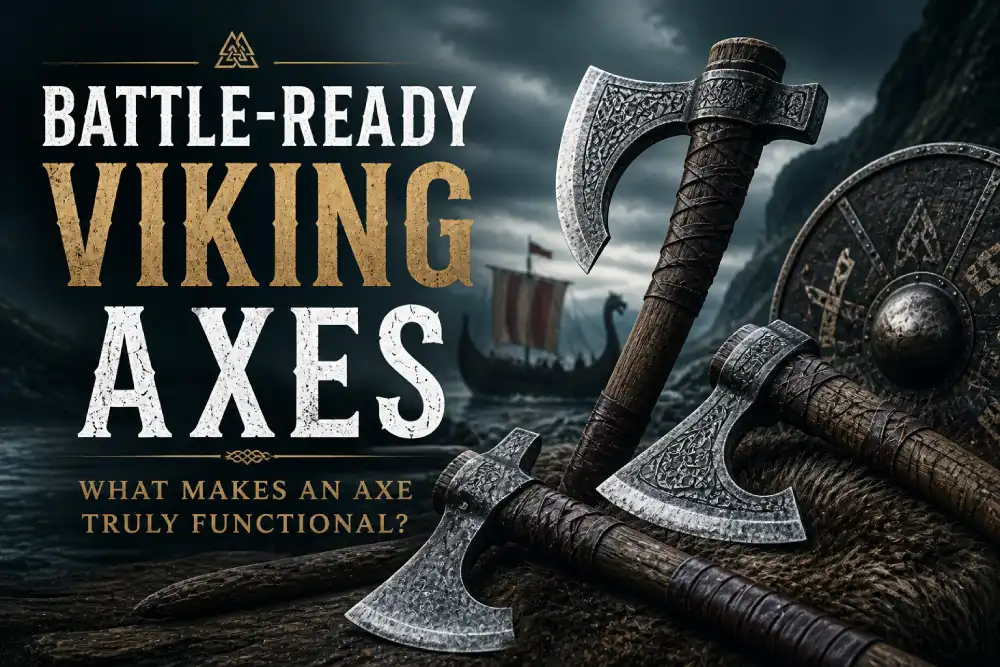
Battle-Ready Viking Axes — What Makes an Axe Truly Functional?
Introduction
Most Viking axes on the market are not Viking axes.
They are shaped like Viking axes. They are photographed like Viking axes. They are sold with words like “authentic” and “hand-crafted” in the listing. But pick one up, swing it at a hardwood target, put it through the demands of real use — and within minutes you know the truth.
The blade chips. The edge folds. The handle splits or the head wobbles loose. The axe that looked so convincing in the product photo turns out to be a prop with a price tag.
A battle-ready Viking axe is a fundamentally different object. It is built — not photographed — to perform. Every decision made in its construction is made with one question in mind: will this hold up when it actually has to?
This guide answers that question in full. What makes a real war axe functional, what to look for when you buy, and why most of what you find on the market falls short.
👉 Shop genuine battle-ready Viking axes at Orion Krafts
What “Battle-Ready” Actually Means
The phrase battle-ready gets thrown around loosely. Let’s define it properly.
A battle-ready Viking axe is one that can withstand repeated real-world use without failing. That means:
- Striking hardwood targets without chipping, cracking, or deforming the edge
- Withstanding impact shock without the head loosening or the haft cracking
- Holding a sharp working edge through extended use and being resharpenable when it dulls
- Performing safely — no unexpected head separation, no structural failure under load
This is not a high bar. A properly constructed axe built from the right materials meets it easily. The problem is that most axes on the market are not properly constructed from the right materials.
Battle-ready is not a marketing category. It is an engineering standard. And it starts with steel.
The Steel Test: This Is Where Most Axes Fail
Steel is the first and most important variable in any functional axe. Get it wrong and nothing else matters. The edge will not hold, the blade will not survive real use, and no amount of good handle work or clever marketing will fix it.
There are two categories of steel you will encounter when shopping for a Viking axe. One is correct. One is not.
High Carbon Steel — The Only Right Answer
High carbon steel — specifically 1075 HC or 1080 HC — is the material a functional Viking axe must be made from. Here is why every variable matters:
Hardness. High carbon steel can be hardened through heat treatment to a Rockwell hardness of HRC 50–58 — hard enough to hold a sharp edge through extended use without deforming. Stainless steel and mild steel cannot be hardened to this level. They are too soft. The edge folds under impact rather than cutting through it.
Toughness. The carbon content in 1075/1080 steel gives it the right balance of hardness and toughness. Hard enough to stay sharp. Tough enough not to shatter under the lateral shock of a glancing blow or a miss that hits the haft eye area. A blade that is too hard without enough toughness becomes brittle — it chips or cracks under impact rather than deforming. 1075/1080 sits in the sweet spot.
Resharpenability. A high carbon blade can be brought back to a working edge with a simple file, whetstone, or strop. This matters enormously for long-term ownership. An axe you can maintain indefinitely is an investment. An axe that cannot be resharpened is a consumable.
Authenticity. Norse blacksmiths worked with high carbon iron and early steel alloys. Modern 1075 and 1080 HC steel is the closest available equivalent to original Norse blade material. A high carbon axe is not just functionally correct — it is historically correct.
The care trade-off. High carbon steel requires minimal maintenance — wipe the blade dry after use, apply a thin coat of oil every few weeks. In exchange, it performs at a level stainless steel cannot reach. This is a 2-minute routine, not a burden.
Stainless Steel — Why It Fails
Stainless steel sounds like an upgrade. It is not. For a functional axe, it is a downgrade in every dimension that matters.
The chromium content that gives stainless steel its corrosion resistance also makes it fundamentally softer at practical blade hardness levels. A stainless blade cannot be hardened to the same Rockwell hardness as 1075 HC without becoming dangerously brittle. The result is a blade that sits in an uncomfortable middle ground — too soft to hold an edge under impact, not tough enough to absorb lateral shock cleanly.
What actually happens with a stainless battle axe:
Strike a hardwood target and the edge rolls. The first few hits feel fine. By the tenth strike, the edge is visibly deformed — not chipped like a tool-hard blade, but folded, mushroomed, rounded off. The sharpness is gone and it cannot be brought back with a simple stone because the geometry has deformed, not just dulled.
Hit slightly off-axis — as happens constantly in real combat or target throwing — and a cheaper stainless alloy can develop stress fractures at the eye or along the blade. In cold temperatures, some stainless alloys become dramatically more brittle.
Stainless steel is a reasonable choice for kitchen knives that live in a damp environment. It is the wrong choice for any axe that will be swung at anything harder than air.
If a seller does not specify the steel type — assume stainless and walk away.

Forging Method: Hand-Forged vs. Machine-Stamped
Steel type is the first filter. Forging method is the second.
Hand-Forged: What It Means and Why It Matters
A hand-forged axe head is worked by a blacksmith — heated in a forge, shaped under a hammer on an anvil, refined through repeated heating and working cycles until the finished geometry is achieved.
This process does something that no machine can replicate: it aligns the grain structure of the steel. As the hammer works the hot steel, the grain flows along the lines of force — along the blade edge, around the eye, through the cheeks of the head. The result is a blade whose internal structure follows its external shape, making it stronger at every point of stress than a blade where the grain runs arbitrarily.
The surface of a hand-forged blade tells you what it is. There will be slight variations in thickness. The finish will have texture — the marks of the smith’s work, not the sterile uniformity of a machine. The eye (where the handle passes through) will show the stretch marks of being punched or drifted, not the clean-cut geometry of a stamped hole.
This is not imperfection. It is evidence of construction. It is the difference between a weapon built by a person who understood what they were making and a product extruded from tooling.
Machine-Stamped: What It Means and Why It Fails
A stamped axe head is punched from flat sheet steel by a press. The process is fast, cheap, and produces dimensionally consistent results at high volume.
It also produces a blade whose grain structure runs across the cutting edge rather than along it. The steel’s internal strength is oriented perpendicular to the direction of use. Under repeated impact — especially lateral impact — stamped heads develop fatigue cracks along the grain lines far faster than forged heads.
You can identify a stamped head by its perfect uniformity. The thickness is identical everywhere. The eye is a clean punched hole with no stretch marks. The surface is smooth and featureless. It looks precisely like what it is: a shape cut from a sheet of steel, not a form worked out of a bar.
For display pieces that will never be struck against anything, stamped is adequate. For any functional use, it is inadequate.
Edge Geometry: The Most Overlooked Variable
Most buyers focus on steel and forging method and overlook the variable that determines day-to-day cutting performance: edge geometry.
The Grind
A functional Viking axe blade should be ground to a convex edge — sometimes called a “appleseed” or “Scandi convex” profile. Looking at the blade cross-section from the spine to the edge, the grind should curve smoothly outward before meeting at the cutting edge.
This geometry achieves two things. It creates a self-steering cut — as the edge enters a medium, the convex cheeks push the material outward, preventing the blade from binding or sticking. And it creates edge durability — the convex profile supports the edge from behind, reducing the chance of chipping or folding under impact compared to a hollow or flat grind.
What to Avoid
A wedge grind — where the blade is simply thick and tapers uniformly to an edge — looks like what people expect an axe to look like. It performs like a maul. It will split things but it will not cut them. For a battle axe, this is wrong.
A hollow grind — concave behind the edge, typical of razors and some kitchen knives — is too fragile for axe use. The thin geometry behind a hollow-ground edge will chip or roll at the first contact with hardwood or bone.
The convex grind is the correct geometry. It is also the hardest to produce on a mass-production line — which is why most cheap axes do not have it.
The Working Edge
A battle-ready axe should arrive with a working sharp edge — meaning it can shave arm hair, slice paper cleanly, and cut into end grain hardwood with controlled force. Not razor-sharp (that geometry is too fragile for an axe), but sharp enough to do real work on the first day you own it.
An axe that ships with an unsharpened edge is a display piece with ambitions. A battle-ready axe is already ready.
Handle (Haft) Construction: The Half That Gets Ignored
The blade gets all the attention. The handle fails first.
A functional Viking axe haft must meet four requirements:
Wood Species and Grain
Ash is the traditional Norse haft material — flexible, tough, light, and abundant across Scandinavia. It absorbs impact shock along the grain rather than transmitting it to the user’s hands and wrists, reducing fatigue over extended use.
Hickory is the preferred modern alternative — slightly denser than ash, with exceptional shock resistance. Many quality haft makers use American hickory as a direct ash equivalent.
Oak is too heavy and too stiff for a combat haft — it transmits too much shock and fatigues the arm quickly. Acceptable for display, wrong for use.
The grain must run parallel to the striking direction — from the butt of the handle toward the head. Cross-grain hafts split along the grain under impact. This is the most common haft failure in budget axes, and it is entirely avoidable by looking at the end grain of the handle before buying.
Haft Shape
A correctly shaped axe haft has a slight swell at the butt — the widening at the base of the handle that prevents the grip from sliding out of the hand on hard strikes. It narrows through the grip zone, then flares slightly at the shoulder where it meets the head.
This shape is not aesthetic. It is ergonomic. A handle without the butt swell will work loose from your grip on hard overhead strikes — sometimes dramatically and dangerously.
Head Fit and Security
The axe head should fit on the haft with absolute solidity — zero wobble, zero play, zero movement under any force short of deliberate disassembly.
The correct fitting method uses a hardwood wedge driven into the top of the haft inside the eye of the head, expanding the wood to fill the eye completely. A secondary steel wedge driven across the grain of the first wedge adds additional security.
Test every axe before committing to it. Grip the head and try to rotate it on the haft. Try to pull it upward. Try to push it down. If there is any movement — any at all — the axe is not battle-ready and potentially dangerous to use.
Length
| Use Case | Correct Haft Length |
|---|---|
| One-handed combat / HEMA | 55–70cm |
| General purpose / versatile | 65–80cm |
| Two-handed / Dane Axe | 100–150cm |
| Display / wall mount | Any — aesthetic preference |
Weight and Balance: What It Should Feel Like
Pick up a battle-ready Viking axe and it should feel front-weighted but controllable. The head dominates the balance — you feel its presence in every swing — but the weight does not feel unmanageable.
Correct head weight by type:
| Axe Type | Head Weight |
|---|---|
| Bearded axe (one-handed combat) | 600–900g |
| Battle axe (one or two-handed) | 900g–1.4kg |
| Dane Axe (two-handed) | 1–2kg |
| Throwing axe | 300–500g |
An axe that feels too light is probably a display piece regardless of what the listing says. An axe that feels impossibly heavy for its intended use is incorrectly built.
The balance point on a one-handed combat axe should sit roughly 5–10cm above the base of the haft — close enough to the head to feel the forward weight, far enough down to give leverage control. Swing it through the air. It should feel like it wants to complete the arc — the head pulling through the strike naturally rather than requiring you to force it.
That feeling — the axe doing part of the work — is the signature of correct weight distribution. It is also what separated a Norse warrior who could fight all day from one who was exhausted by the third engagement.
The Red Flag Checklist
Before buying any axe marketed as “battle-ready,” run this checklist:
- ❌ Steel type not specified — if they won’t tell you, it’s not high carbon
- ❌ “Stainless steel” — wrong material for a functional axe
- ❌ Under $50 — hand-forged high carbon axes have real material and labour costs
- ❌ Perfect uniform surface finish — sign of machine stamping
- ❌ No mention of forging method — assume stamped
- ❌ Loose head on arrival — reject immediately
- ❌ Chrome plating or mirror polish — costume prop
- ❌ Hollow plastic or resin handle — not worth discussing
- ❌ No sharpened edge — display piece, not battle-ready
- ❌ Photos only on white background — no real-use context is a red flag
Frequently Asked Questions
What is a battle-ready Viking axe? A battle-ready Viking axe is one built to withstand real-world use — HEMA sparring, reenactment, target striking, or general functional use. It requires high carbon steel (1075 or 1080 HC), hand-forged construction, correct edge geometry, a quality hardwood haft with secure head fitting, and a working sharp edge on delivery.
What steel is used in a real war axe? Authentic functional war axes use high carbon steel — typically 1075 HC or 1080 HC. This steel can be hardened to the correct Rockwell hardness for edge retention, is tough enough to handle lateral impact, and can be resharpened indefinitely. Stainless steel cannot match these performance characteristics.
How do I know if my Viking axe is functional? Check: the steel type (must be high carbon), the construction method (must be forged, not stamped), the edge (must arrive sharp and hold that edge through use), the haft grain direction (must run parallel to the strike), and the head security (must have zero wobble). An axe that passes all five is functional. One that fails any of them is not.
What is the difference between a display axe and a battle-ready axe? A display axe is built to look like a Viking axe — it prioritises visual accuracy and finish quality over functional performance. A battle-ready axe is built to perform like a Viking axe — every material and construction decision is made for durability and functional use. The best axes are both.
Can a battle-ready axe also be a display piece? Absolutely — and the best ones are. A hand-forged high carbon axe with a quality forge finish and correct historical proportions is as visually compelling as any display-only piece. The difference is that it can also be used. At Orion Krafts, every axe is built to perform and display at the same standard.
Conclusion
The difference between a battle-ready Viking axe and a prop is not visible in a photograph.
It is in the steel. In the grain of the forging. In the geometry of the edge and the way the wood grain runs through the haft. In the solid, locked-down fit of the head and the forward weight of a blade that was built to swing, not to sit.
A real war axe does not need to announce itself. Pick it up. Feel the weight settle forward. Run a thumb across the edge. Swing it once through the air and feel the head pull the arc to completion.
You will know immediately whether you are holding a weapon or a decoration.
At Orion Krafts, every axe is hand-forged in high carbon steel, built to historical specifications, and arrives ready to use from the day it reaches your hands.
👉 Shop genuine battle-ready Viking axes at Orion Krafts — built to perform, built to last →
Related Reading:


Add comment