
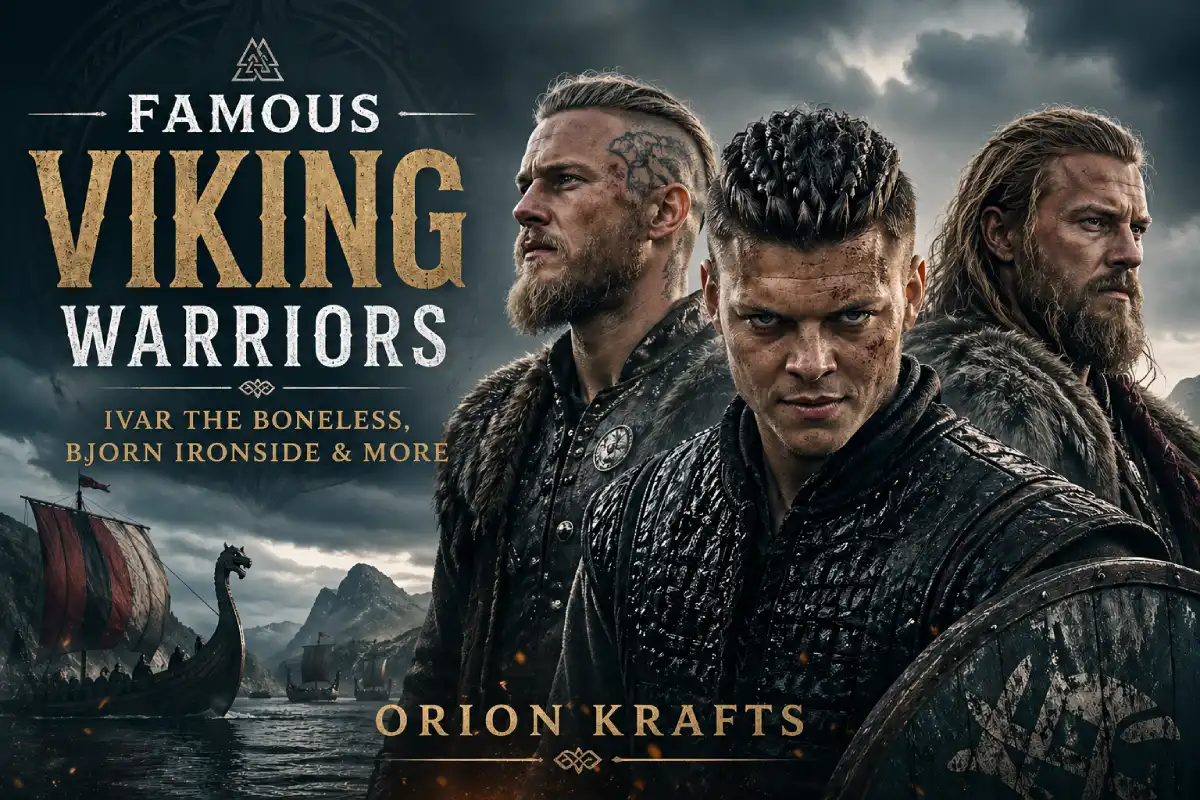
Famous Viking Warriors — Ivar the Boneless, Bjorn Ironside & More
Introduction
History remembers its monsters.
And in the 9th and 10th centuries, no name carried more dread across the kingdoms of England, France, and Ireland than the names of the great Norse warriors. Kings barricaded their cities. Monasteries hid their gold. Armies twice the size of the Norse forces turned and ran.
These were not myths. These were men.
Men who crossed the open ocean in open boats, navigated by stars and instinct, and arrived on foreign shores carrying axes and an absolute refusal to lose. Men whose names were written down by terrified monks who had survived raids, by enemies who respected them too much to lie about what they had seen, and by later Norse skalds who turned their deeds into poetry that lasted a thousand years.
This is who they were. What they actually did. And why, more than a millennium later, the world still knows their names.
👉 Carry their legacy — shop authentic Viking axes at Orion Krafts
Ragnar Lothbrok — The Warrior Who Started Everything
Before Ivar. Before Bjorn. Before the Great Heathen Army that nearly destroyed Anglo-Saxon England — there was Ragnar Lothbrok.
The Man Behind the Legend
Ragnar Lothbrok — Lothbrok meaning “shaggy breeches” in Old Norse — sits at the intersection of history and myth in a way that makes separating the two genuinely difficult. He appears in multiple Norse sagas, several medieval chronicles, and has been credited with raids on Paris, England, and Ireland from the 840s onward.
Whether Ragnar was one man or a composite of several real Norse chieftains is still debated. What is not debated is this: the raids credited to him were real, the fear they generated was documented, and the sons who avenged his death were very, very real indeed.
The Death That Changed History
According to Norse saga tradition, Ragnar was captured by King Ælla of Northumbria — the English king who governed the Viking-raided north of England — and executed by being thrown into a pit of venomous snakes.
As he died, the saga records his last words: “How the young pigs would grunt if they knew what the old boar suffers.”
His sons — Ivar, Bjorn, Halfdan, Ubbe, and Sigurd — made sure King Ælla understood the reference.
Why He Matters
Ragnar Lothbrok is the origin point. Every great Norse warrior of the 9th century either descended from him, fought with him, or defined themselves against his legacy. Understanding Ragnar means understanding what came after.
Ivar the Boneless — The Most Feared Viking Who Ever Lived
The Name
Ivar Ragnarsson — known to history as Ivar the Boneless — is the most searched Viking warrior for a reason. He was, by any measure, the most strategically brilliant, most ruthlessly effective, and most genuinely terrifying Norse commander of the entire Viking Age.
What “the Boneless” means is still argued. The most credible theories suggest either a condition like osteogenesis imperfecta (brittle bone disease) that required him to be carried into battle, or that beinlausi — boneless in Old Norse — was a metaphor for his extraordinary flexibility as a strategist, a man with no fixed principles who bent in whatever direction served his goals. A third theory suggests it referred to sexual impotence, used as an insult that somehow became a legend.
What is agreed: Ivar fought. Ivar won. And Ivar did things that made even hardened Norse warriors uncomfortable.
The Great Heathen Army
In 865 AD, the sons of Ragnar Lothbrok arrived in England.
Not to raid. To conquer.
The Great Heathen Army — mycel hæþen here in the Anglo-Saxon Chronicle — landed in East Anglia with an estimated force of several thousand warriors, the largest Viking invasion force England had ever seen. Ivar commanded alongside his brothers Halfdan and Ubbe.
Within a year, they had taken York — one of the most fortified cities in England. Within two years, they controlled Northumbria. Within five, they had shattered the kingdoms of East Anglia and Mercia and reduced Wessex to its last defensible corner.
The Death of Ælla
King Ælla — the man who had (allegedly) executed Ragnar Lothbrok — was captured at York.
What happened next is recorded in Norse sources as the blood eagle — a ritual execution of almost incomprehensible brutality, performed by Ivar personally. The historical accuracy of the blood eagle ritual is debated by scholars, but the fact that Ælla died at Ivar’s hands shortly after the capture of York is not.
Ragnar’s last words had been about the young pigs and the old boar.
Ivar made sure Ælla understood them.
The Strategist
What set Ivar apart from other Norse commanders was his mind. He was not simply a fearsome axe-warrior — though contemporary accounts suggest he was terrifying in personal combat. He was a political operator, a logistician, and a long-term planner in an era when most military strategy extended about 48 hours into the future.
He negotiated, manipulated, and manoeuvred English kings against each other. He used the threat of the Great Heathen Army as leverage even when he did not intend to fight. He understood that the goal was not to kill everyone in England — it was to control England. That distinction made him uniquely dangerous.
The Warrior’s Weapons
A commander of Ivar’s status would have carried the finest weapons Norse smiths could produce — a bearded axe with a forge-welded high carbon edge, possibly engraved with runic protective symbols, mounted on a hardwood haft reinforced for heavy combat. His status as a son of Ragnar Lothbrok meant access to the best armour and the best steel available in the 9th-century Norse world.
👉 Shop Norse battle axes — forged to the standard a warrior like Ivar would carry
Bjorn Ironside — The Warrior Who Raided the Mediterranean
If Ivar was the mind of the Ragnarsson brothers, Bjorn Ironside was the ambition.
The Name
Járnsíða — Ironside — earned through a reputation for being essentially impossible to wound in battle. Whether this was literal (extraordinary armour) or metaphorical (extraordinary toughness) depends on the source. What is consistent is that Bjorn survived situations that killed lesser men, accumulated a personal fortune that rivalled kings, and died of old age in his bed — an achievement almost uniquely rare among the great Viking warriors.
The Mediterranean Raid
In 859–862 AD, Bjorn Ironside and the Norse commander Hastein led a fleet of 62 longships on the most ambitious Viking expedition ever attempted: a three-year raid of the Mediterranean.
They raided the Iberian coast. They crossed into North Africa and raided the Moroccan shoreline — becoming the first Norse warriors to set foot on the African continent. They sacked the French coastal town of Narbonne. They crossed into the Balearic Islands. They entered the Italian coast and sacked Luna — which Bjorn reportedly mistook for Rome.
They came home three years later with two ships loaded entirely with gold, silver, and slaves. Sixty ships had gone out. Forty came back. But by any measure of the era — territory covered, wealth extracted, enemies killed — it was an extraordinary achievement.
No other Norse expedition ranged as far or as boldly as Bjorn’s Mediterranean raid. He turned the entire known world into his raiding ground.
The King of Sweden
In his later years, Bjorn Ironside established himself as a king in Sweden — specifically associated with the ancient royal seat of Uppsala. Norse sagas credit him as the founder of the Munsö dynasty, the royal line that would rule Sweden for generations.
He went from raider to king. From the son of a legendary father to a legendary figure himself.
The axe that built an empire. The same axe that hangs on your wall.
👉 Shop Viking axes worthy of a king’s collection
Harald Hardrada — The Last Great Viking Warrior
Three hundred years after Ragnar’s sons carved England apart, one man stood as the final expression of the Norse warrior tradition.
Harald Sigurdsson — known to history as Hardrada, meaning “hard ruler” — was, by the assessment of most medieval historians, the greatest warrior of the 11th century. Possibly the greatest individual fighter the Viking Age ever produced.
The Biography That Reads Like Fiction
Harald’s life was so eventful that summarising it feels like cheating:
- At 15, he fought at the Battle of Stiklestad in Norway (1030 AD) on the losing side, was wounded, and escaped through the wilderness.
- He fled to Kievan Rus, served as a mercenary under Yaroslav the Wise, and led raids deep into Eastern Europe.
- He joined the Varangian Guard — the elite Norse mercenary corps that served the Byzantine Emperor in Constantinople — and rose to command it.
- He fought campaigns in Bulgaria, the Mediterranean, Asia Minor, and Jerusalem.
- He accumulated enough gold in Byzantine service to return to Scandinavia and buy an army.
- He became King of Norway in 1046.
- He invaded Denmark and fought a nine-year war for the Danish crown.
- In 1066, he invaded England with 300 longships and 15,000 men, claiming the English throne.
He was 51 years old when he landed in England. He had been fighting almost continuously for 36 years.
Stamford Bridge
Harald Hardrada’s invasion was stopped at the Battle of Stamford Bridge on 25 September 1066 by King Harold Godwinson’s English army. The battle is famous for the lone Norse warrior — armed with a Dane Axe — who held the bridge against the entire English army for long enough that Harald could organise his forces.
Harald was killed by an arrow through the throat in the battle’s final stage. He died fighting, on his feet, still advancing.
Three days later, William the Conqueror landed in the south of England. King Harold Godwinson, exhausted from Stamford Bridge, force-marched his army 300 miles south and died at Hastings.
Some historians argue that without Harald Hardrada’s invasion forcing Harold north, Hastings would have gone differently. That the last great Viking warrior, in dying, changed the course of English history.
The Varangian Axe
Harald’s years in the Varangian Guard made him one of the most experienced axe-fighters in the world. The Varangians were famous across the Byzantine world for their enormous Dane Axes — the pelekys in Greek sources — which they carried on their shoulders in ceremonial processions and swung two-handed in battle.
A Varangian warrior’s axe was their identity, their career, and their pension plan. It was valued above everything else they owned.
Leif Erikson — The Viking Who Found America
Not every great Norse warrior conquered through blood. Some conquered through distance.
Leif Erikson — son of Erik the Red, Norse settler of Greenland — sailed west from Greenland around 1000 AD and landed on the coast of North America. He called it Vinland.
Five hundred years before Columbus. Four hundred years before any other European on record.
He did not raid. He explored. He built a settlement at L’Anse aux Meadows in modern Newfoundland — the only confirmed Norse settlement site in North America, excavated in the 1960s and now a UNESCO World Heritage Site.
Leif Erikson did not conquer the world with an axe. He discovered it with one.
The Norse warrior was not just a raider. He was the greatest explorer the medieval world produced.
Erik the Red — The Man Too Violent for Iceland
Erik Thorvaldsson — Erik the Red, named for his hair and his temper — was exiled from Norway for manslaughter. Then exiled from Iceland for more manslaughter.
Rather than sit quietly and reform his character, Erik sailed west into the unknown North Atlantic and discovered Greenland — an island larger than Western Europe. He colonised it, ruled it, and built a settlement that survived for 500 years.
He was too violent for two countries. He responded by finding a third one.
That is the Norse warrior spirit in a single biography.
What Made a Viking Warrior?
These men were not born legendary. They were forged by a culture that valued specific qualities above all others:
Physical courage — the willingness to stand in a shield wall and be the first man to advance, knowing the person running at you wants to kill you.
Endurance — crossing the North Atlantic in an open boat, sleeping on deck in freezing rain, fighting the same day you arrived. No quarter asked or expected.
Skill with weapons — from childhood. An axe was the first tool a Norse boy learned. By adulthood, the best warriors had trained for more than a decade.
Reputation — in Norse culture, a man’s name outlasted his body. The worst thing was not death. It was dying nameless — without deeds, without stories, without anyone to remember you. Great warriors fought partly to earn a name worth carrying into the future.
The weapons these men carried were not incidental to who they were. The axe was their identity — forged in the same fires as their reputations, carried through the same storms.
👉 Own the weapon they carried — hand-forged Viking axes at Orion Krafts
Frequently Asked Questions
Was Ivar the Boneless a real person? Yes. Ivar Ragnarsson appears in multiple historical sources, including the Anglo-Saxon Chronicle, which records his leadership of the Great Heathen Army’s invasion of England in 865 AD. The execution of King Ælla of Northumbria is historically documented. The details of his physical condition are debated, but his existence and military achievements are not.
Was Bjorn Ironside a real Viking? Yes. Bjorn Ironside appears in Frankish annals recording the Mediterranean raid of 859–862 AD, corroborating the Norse saga accounts. He is also referenced in sources connecting him to early Swedish royal history. Like most Viking Age figures, the mythological embellishments are significant, but the historical core is real.
Was Ragnar Lothbrok a real person? This is genuinely uncertain. Several historical figures from the 9th century share characteristics with the Ragnar of the sagas, leading most historians to conclude he was either a real chieftain whose biography was heavily mythologised, or a composite of several real Norse leaders. His sons — Ivar, Bjorn, Halfdan, Ubbe — are all historically documented.
What weapons did famous Viking warriors use? The primary weapon for most Norse warriors was the axe — specifically the bearded axe for rank-and-file warriors and hirðmen, and the Dane Axe for elite huscarl warriors. Elite commanders like Ivar and Harald Hardrada would have carried the finest available axes, often with runic engravings or decorative inlay marking their status.
Who was the greatest Viking warrior? Harald Hardrada is the most commonly cited candidate for the greatest individual Viking warrior — combining 36 years of combat experience across four continents with command-level strategic ability and documented personal bravery. Ivar the Boneless is the strongest candidate for greatest Norse military commander overall.
What happened to the Viking warriors? The Viking Age ended with the Battle of Hastings in 1066 — the death of Harald Hardrada at Stamford Bridge being the conventional close. Norse warriors did not disappear; they assimilated into the kingdoms of England, France, Russia, and Sicily that their ancestors had raided or settled. The Normans who conquered England in 1066 were themselves descendants of Norse settlers in northern France.
Conclusion
These were not comfortable men.
They were shaped by a world where the sea could kill you before the enemy did, where reputation was the only currency that outlasted death, and where standing still was just dying slowly in the wrong direction.
Ivar the Boneless dismantled Anglo-Saxon England with a combination of tactical genius and absolute ruthlessness. Bjorn Ironside sailed further than any European of his age for the pure ambition of it. Harald Hardrada spent 36 years in continuous combat across four continents and died on his feet, still advancing.
They carried axes. Not as symbols. As tools. As extensions of who they were — men who had decided what they wanted from the world and went to take it.
The axe is still the right object. Hand-forged. High carbon steel. Built to last as long as their names.
👉 Shop authentic hand-forged Viking axes at Orion Krafts — carry the legacy forward →
Related Reading:

Add comment