Viking Symbols and Their Meanings — Vegvisir, Valknut & More
Introduction
The Vikings did not just fight. They believed.
Every axe blade, every shield boss, every longship prow carried marks that meant something — symbols drawn from a cosmology so rich and layered that modern scholars are still untangling it. These were not decorations. They were declarations. A warrior who carved the Vegvisir into his weapon was not making it prettier. He was making it protected.
Norse symbols were a language written in iron and ink, bone and stone. They spoke of gods, fate, death, protection, victory, and the invisible forces that shaped a world where a man could be alive at dawn and dead by noon.
A thousand years later, these symbols are tattooed on arms, engraved on blades, and worn around necks from Oslo to Los Angeles. Their power has not faded. If anything, it has grown.
Here is what each one means — and where it came from.
1. Vegvisir — The Viking Compass
What It Looks Like
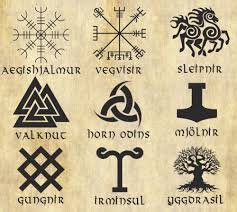
Eight runic staves radiating from a central point, like a compass rose made of angular Norse script. No two arms are identical — each stave has a different combination of branches and points.
What It Means
Vegvisir translates from Old Norse as “wayfinder” or “signpost” — from vegr (way, path) and vísir (guide, pointer).
The symbol appears in the Huld Manuscript, an Icelandic grimoire compiled in the 19th century from older Norse magical traditions. The text accompanying it reads: “If this sign is carried, one will never lose one’s way in storms or bad weather, even when the way is not known.”
The History Behind It
The Vegvisir is not a Viking Age archaeological find — it appears in post-Viking Icelandic magical manuscripts, meaning its exact origins in the Viking world are debated by scholars. What is not debated is its connection to the Norse worldview — a civilisation built around navigation, where the ability to find your way across open ocean in a storm was literally the difference between life and death.
To a Norse sailor, a symbol that promised safe passage through storm and darkness was not superstition. It was survival. The Vegvisir captured something the Vikings understood at a bone-deep level: that the world is hostile and vast, and the man who can navigate it without losing his way is worth more than the man who cannot.
On Axes and Hammers
The Vegvisir engraved on a blade carries that same energy forward — a weapon that protects, guides, and brings its bearer home. At Orion Krafts, the Vegvisir appears on hand-forged axe blades and hammer heads as one of the most requested Norse symbols.
👉 Shop Vegvisir-engraved Viking axes 👉 Shop Vegvisir-engraved Viking hammers
2. Valknut — The Knot of the Slain
What It Looks Like
Three interlocking triangles — sometimes drawn as three separate triangles woven together (borromean style), sometimes as one continuous nine-pointed knot (unicursal style). Stark, geometric, instantly recognisable.
What It Means
Valknut is a modern Norse-derived name — valr (the slain in battle) and knut (knot). The symbol itself has no surviving Old Norse name. What it has is context — and that context is unmistakable.
The Valknut appears carved on Gotlandic picture stones — large standing memorial stones from 5th to 12th century Scandinavia — almost exclusively in scenes depicting death, battle, and the afterlife. Specifically, it appears alongside images of Odin and Valhalla. On the Stora Hammars I stone, the Valknut appears directly below a scene of human sacrifice.
The History Behind It
The Valknut was Odin’s symbol. Not officially — no surviving Norse text names it as such — but archaeologically, the pattern is consistent and undeniable. Every time the Valknut appears in Viking Age art, Odin is nearby.
What did it mean to a Norse warrior? Likely this: that the man who bore this symbol had given himself to Odin. That death in battle was not an ending but a doorway — into Valhalla, into the company of the einherjar (the honoured war dead), into an eternity of feasting and fighting until Ragnarök.
A warrior who carved the Valknut onto his weapon was not afraid of dying. He was claiming death as a destination.
On Axes and Hammers
The Valknut on a blade is one of the most powerful statements in Norse symbolism — a warrior’s declaration that he fights without fear of the outcome. On an Orion Krafts axe or hammer, it is engraved deep into the steel.
👉 Shop Valknut-engraved Viking axes 👉 Shop Valknut-engraved Viking hammers
3. Helm of Awe (Ægishjálmr) — Terror Made Visible
What It Looks Like
Eight trident-shaped arms radiating from a central point — like the Vegvisir’s angular, militant brother. Each arm is identical, unlike the Vegvisir’s asymmetric staves. The overall shape has an aggressive, outward-pointing energy that the Vegvisir does not.
What It Means
Ægishjálmr — the Helm of Awe, or Helm of Terror — is one of the most powerful protective symbols in Norse mythology. The name translates as “helmet of awe/terror,” but this was never a physical helmet. It was a symbol of invisible armour — a force projected outward that paralysed enemies and made them unable to fight effectively.
The Poetic Edda references it directly. The dragon Fáfnir — the greatest hoard-guardian in Norse myth — claims to wear the Ægishjálmr between his eyes, crediting it with making all enemies fear him. When Sigurd kills Fáfnir, he finds the Ægishjálmr among the treasure hoard.
The History Behind It
Norse warriors drew the Ægishjálmr on their foreheads before battle — pressing the symbol into the skin between the eyes using a finger dipped in whatever pigment or blood was available. The idea was not that the symbol would stop a sword. It was that enemies who looked at the warrior bearing the Helm of Awe would feel a creeping, irrational terror — their courage draining, their weapon hands faltering.
In a shield wall where morale and nerve were often the deciding factor, a symbol that could break an enemy’s will before the first blow landed was worth everything.
On Axes and Hammers
The Helm of Awe engraved on an axe blade carries forward that same energy — a weapon that does not just cut, but intimidates. Paired with the visual presence of a hand-forged Norse blade, it lands exactly as intended.
👉 Shop Helm of Awe Viking axes 👉 Shop Helm of Awe Viking hammers
4. Mjolnir — The Hammer of Thor
What It Looks Like
A short-handled hammer with a wide, blocky head — disproportionately short in the handle compared to the head, which is explained in Norse mythology by the story of how it was made. Typically worn as a pendant in Viking Age contexts.
What It Means
Mjolnir is Thor’s hammer — the weapon of the thunder god, the protector of Asgard and humanity, the destroyer of giants. Its name likely derives from an Old Norse root meaning lightning or crusher.
In Norse mythology, Mjolnir was forged by the dwarven smiths Brokkr and Sindri in a competition wagered by Loki. Loki — as Loki does — sabotaged the forge by transforming into a fly and biting the bellows operator at a critical moment. The result: a hammer with a handle slightly too short. Despite the imperfection, it became the most powerful weapon in all of the Nine Realms.
The History Behind It
Mjolnir pendants are among the most common Viking Age artefacts found across Scandinavia, Britain, and Russia — over a thousand have been recovered to date. They were worn by warriors, farmers, women, and children alike as a symbol of Thor’s protection.
In the 10th and 11th centuries, as Christianity spread through Scandinavia, the Mjolnir pendant became a deliberate statement of Norse religious identity — a direct counterpart to the Christian cross, worn to declare that the bearer worshipped the old gods, not the new one.
Finding a Viking Age burial with a Mjolnir pendant around the neck is finding someone who, even in death, made a choice about which power they trusted.
On Axes and Hammers
The Mjolnir is not just a necklace. It is one of the most powerful symbols in Norse culture — and engraved on a hammer or axe, it ties the weapon directly to Thor’s protection and power.
👉 Shop Mjolnir Viking axes 👉 Shop authentic Mjolnir hammers
5. Yggdrasil — The World Tree
What It Looks Like
An enormous ash tree, its branches spreading across the sky, its roots reaching down through the Nine Realms. In carved and illustrated form, typically depicted as a stylised tree with interweaving roots and branches, often with creatures — the eagle at the top, the serpent Níðhöggr at the roots — worked into the design.
What It Means
Yggdrasil is the World Tree — the cosmic axis around which all of Norse existence is organised. Its name means “Odin’s horse” in Old Norse (Yggr being one of Odin’s names, drasill meaning horse) — a reference to the World Tree as the gallows on which Odin hung himself for nine days to gain the knowledge of the runes.
The tree connects all Nine Realms — from Asgard at the crown to Niflheim at the roots. Its health reflects the health of the cosmos. When it shakes, the universe shudders. At Ragnarök, it burns.
On Axes and Hammers
Yggdrasil engraved on a blade is a statement about the Norse worldview in its entirety — the interconnectedness of all things, the cyclical nature of creation and destruction, the warrior’s place within a cosmos larger than himself.
👉 Shop Yggdrasil-engraved Viking axes 👉 Shop Yggdrasil Viking hammers
6. The Runes — Odin’s Greatest Gift
What They Are
The runic alphabet — Elder Futhark (24 characters, primarily Viking Age) and Younger Futhark (16 characters, developed during the Viking Age) — was the written script of the Norse world. Each rune had a name, a phonetic value, and a symbolic meaning. They were carved onto weapons, memorial stones, tools, and jewellery.
What They Meant
Odin obtained the runes by hanging upside down from Yggdrasil for nine days and nine nights, pierced by his own spear, neither eating nor drinking — a death and rebirth ritual to receive divine knowledge. The runes were not just letters. They were forces. Carving a rune was invoking the power it represented.
Key individual runes and their meanings:
- Tiwaz (ᛏ) — named for Tyr, the god of war and justice. Carved on weapons to grant victory in battle.
- Algiz (ᛉ) — protection, connection to the divine. A ward against danger.
- Sowilo (ᛋ) — the sun rune. Victory, power, success. Also — notoriously — adopted by the SS in the 20th century, a legacy that has nothing to do with its Norse origins.
- Othala (ᛟ) — heritage, homeland, ancestral property. The rune of roots and belonging.
- Fehu (ᚠ) — wealth, abundance, cattle. The first rune of the Elder Futhark.
Individual runes carved on weapons were not decoration. They were specific requests — victory, protection, strength, good fortune — made in a language that the Norse believed the cosmos could read.
On Axes and Hammers
A blade engraved with runic characters carries forward the oldest Norse magical tradition. Each rune is a word spoken in steel.
👉 Shop runic-engraved Viking axes 👉 Shop runic Viking hammers
7. The Triquetra — The Triple Knot
What It Looks Like
Three interlocking arcs forming a continuous, symmetrical three-cornered knot. Smooth and curved where the Valknut is angular and geometric.
What It Means
The Triquetra — from Latin triquetrus, meaning three-cornered — appears in Norse, Celtic, and early Christian contexts. In Norse tradition it is associated with the three interconnected forces of the Norse world: the past, present, and future governed by the three Norns (Urðr, Verðandi, and Skuld), or alternatively with Odin’s triple nature, or with the three realms of sky, sea, and earth.
Its continuous, unbroken line represents things without beginning or end — the cyclical nature of time, fate, and the cosmos.
8. The Serpent — Jormungandr
What It Looks Like
A great serpent biting its own tail — the ouroboros form — representing the World Serpent encircling Midgard beneath the ocean.
What It Means
Jormungandr is the Midgard Serpent — child of Loki, sibling of Fenrir and Hel, enemy of Thor. Its body encircles the entire world, its tail in its own mouth. When Jormungandr releases its tail, Ragnarök begins.
As a symbol, Jormungandr represents the boundary of the known world — and the terrifying, incomprehensible force beyond it. For a Norse warrior, bearing this symbol was an acknowledgement that the world has limits, that chaos waits at the edges, and that courage means facing it anyway.
Why These Symbols Belong on Steel
Norse symbols were never meant for paper. They were carved into wood, hammered into metal, scratched into bone. They lived on surfaces that moved through the world — weapons, tools, ships, jewellery — not in manuscripts gathering dust.
A Viking axe or hammer engraved with the Vegvisir, Valknut, Helm of Awe, or Mjolnir is not a novelty. It is the correct medium for these symbols. The form they were always meant to take.
At Orion Krafts, every engraved axe and hammer is hand-forged in high carbon steel, carrying these symbols exactly as Norse smiths intended them — cut into metal that will last as long as the myths themselves.
👉 Browse engraved Viking axes — Vegvisir, Valknut, Helm of Awe & more 👉 Browse Norse symbol Viking hammers — Mjolnir, Yggdrasil & more
Frequently Asked Questions
What is the most powerful Viking symbol? The Helm of Awe (Ægishjálmr) is widely considered the most powerful protective symbol in Norse tradition — used specifically to inspire terror in enemies and protect the bearer in battle. Mjolnir is arguably the most universally significant, tied to Thor’s protection of both gods and humanity.
What does the Vegvisir symbol mean? Vegvisir means “wayfinder” in Old Norse. It is a magical stave believed to guide the bearer safely through storms and bad weather, ensuring they never lose their way. It appears in the Icelandic Huld Manuscript alongside the text: “If this sign is carried, one will never lose one’s way.”
What is the Valknut symbol? The Valknut is three interlocking triangles associated with Odin and the honoured war dead. It appears on Viking Age memorial stones in scenes depicting death, battle, and Valhalla. It likely symbolised a warrior’s dedication to Odin and acceptance of death in battle as a doorway to the afterlife.
Are Viking symbols still used today? Yes — widely. Norse symbols appear in tattoo culture, jewellery, weapon engravings, and spiritual practice (particularly within Ásatrú and Norse heathenry). Most are reclaimed from their original historical context; a few (notably the Sowilo rune) have been misappropriated by extremist groups, though their Norse meanings have nothing to do with those associations.
What Viking symbols are good for protection? The primary protective Norse symbols are the Vegvisir (safe navigation), Ægishjálmr/Helm of Awe (terror projected outward, body protected), Mjolnir (Thor’s direct protection), and Algiz rune (divine protection). All four appear regularly on Viking Age weapons and personal items.
Conclusion
The Norse symbols that covered Viking weapons were not art projects.
They were requests — made in the only language the cosmos understood. Carved into steel by smiths who believed that a blade bearing the right marks was not just sharper, but luckier. Not just strong, but protected. Not just a weapon, but a declaration about the man who carried it.
The Vegvisir says: I will not be lost. The Valknut says: I am not afraid to die. The Helm of Awe says: My enemies will know fear before they know pain. Mjolnir says: I stand under Thor’s protection.
A thousand years of history. Still written in iron.
👉 Shop engraved Viking axes at Orion Krafts — Norse symbols forged in high carbon steel → 👉 Shop Norse symbol Viking hammers at Orion Krafts →

Add comment