Thor’s Hammer (Mjolnir) — History, Meaning & Real Replicas
Introduction
In all of Norse mythology — across every saga, every Edda, every carved stone and painted shield — no weapon is more feared, more celebrated, or more powerful than Mjolnir.
Not Odin’s spear Gungnir. Not the sword Tyrfing. Not the axes carried by a thousand Viking warriors into a thousand raids.
Mjolnir.
Thor’s hammer.
The weapon that killed giants. That blessed marriages and sanctified the dead. That hung around the necks of Norse warriors as the last thing they wanted near their heart before battle. The weapon that the gods of Asgard themselves feared losing — because without it, the walls of their world would fall.
This is the complete history of Mjolnir — where it came from, what it meant to the people who worshipped it, and what a real hand-forged replica looks like in your hands today.
👉 Shop authentic hand-forged Mjolnir hammers at Orion Krafts
The Mythology: How Mjolnir Was Made
Every great weapon has an origin story. Mjolnir’s is one of the best in world mythology — and like most Norse stories, it starts with Loki causing a catastrophic problem.
Loki’s Wager
Loki, the trickster god, cut off the golden hair of Sif — Thor’s wife — while she slept. When Thor found out, his rage was volcanic. To save himself from a genuinely deserved beating, Loki made a promise: he would travel to Svartalfheim, the realm of the dwarves, and have Sif’s hair replaced with spun gold so fine and magical it would grow like real hair.
While in Svartalfheim, Loki visited the master craftsmen Ivaldi’s Sons — the greatest smiths in the Nine Realms. They forged Sif’s golden hair, and while the forge was hot, added two more gifts: Skidbladnir (a ship that could sail any sea and fold down to fit in a pocket) and Gungnir (Odin’s spear, which never misses its mark).
Loki, being Loki, immediately made things worse. He wagered his own head against a rival pair of dwarven smiths — Brokkr and Sindri — betting they could not match Ivaldi’s creations. The brothers accepted.
The Sabotage
Sindri started working. The first item to emerge from the forge was Gullinbursti — a golden boar for the god Freyr, whose bristles shone bright enough to light the darkest realm.
The second was Draupnir — a gold ring for Odin. Every ninth night, eight rings of equal weight would drip from it.
The third was Mjolnir.
But Loki was not going to lose his head without interference. He transformed into a fly and bit Brokkr — the one working the bellows — repeatedly during the forging. For the first two items, Brokkr ignored the pain. During the forging of Mjolnir, Loki bit him on the eyelid so hard that blood ran into his eye. Brokkr flinched. Just for a moment. Just long enough.
Mjolnir emerged from the forge with one fatal flaw.
The handle was too short.
The Judgement
The gods of Asgard evaluated the gifts. Skidbladnir was magnificent. Gungnir was flawless. Gullinbursti blazed with light. Draupnir was perfection in gold.
And Mjolnir — imperfect, short-handled Mjolnir — was declared the greatest treasure of all.
Because what Mjolnir could do, nothing else could. It could level mountains. It could kill anything alive. It could be thrown and would always return to Thor’s hand. And it was the only weapon in all the realms capable of defending Asgard against the giants — the eternal enemies who, without Mjolnir, would have torn the gods’ world apart.
A short handle was a flaw. But Mjolnir’s power made every other weapon obsolete. The gods did not care about perfection. They cared about survival.
Loki kept his head. Technically. The gods ruled that he had wagered his head, not his neck — so Brokkr could not take it cleanly. Loki’s lips were sewn shut instead.
Even in defeat, the trickster found a loophole.
Mjolnir in Norse Mythology: More Than a Weapon
Modern audiences — shaped by Marvel’s Thor — think of Mjolnir primarily as a weapon. The Norse knew it as something far more complex.
The Giant Killer
Yes, Mjolnir killed giants. Constantly, enthusiastically, and with a body count that makes Thor the most prolific giant-slayer in all of Norse mythology.
The most dramatic example is the myth of Thrym’s Theft. The frost giant Thrym stole Mjolnir and buried it eight leagues underground, then offered to return it on one condition: he wanted the goddess Freya as his bride.
The gods refused. Freya, magnificently, also refused — the ground shaking with her fury.
Instead, Thor disguised himself as a bride and attended the wedding personally. When Mjolnir was brought out to bless the marriage — a standard Norse wedding ritual — Thor grabbed it, dropped the disguise, and killed every giant in the hall.
This myth is extraordinary for two reasons. First: it confirms that Mjolnir was irreplaceable — so critical to Asgard’s defence that the gods considered dressing their most powerful warrior as a woman preferable to losing it permanently. Second: it establishes that Mjolnir was used in wedding ceremonies as a blessing. This was not just a war hammer. It was sacred.
The Sanctifier
Across multiple Norse sources, Mjolnir is held over newborns to bless them, placed in the laps of brides to ensure fertility, and laid on the chests of the dead to consecrate them for burial.
Thor was not just a god of war and storms. He was the protector of ordinary people — farmers, sailors, families. Mjolnir was the symbol of that protection. When a child was born under hard circumstances or a couple married against the odds, calling on Thor’s hammer was calling on the power of the divine to stand between the fragile human world and everything that threatened it.
Thor’s Relationship with Mjolnir
Thor wore iron gloves (Járngreipr) to grip Mjolnir’s short handle, and a belt (Megingjörð) that doubled his already superhuman strength when worn. Without these items, even Thor — the strongest being in the Nine Realms — could not wield Mjolnir to its full capacity.
The hammer returns to his hand after every throw. It cannot be permanently lost or destroyed (Thrym’s theft notwithstanding). It is as much a part of Thor as his red beard and his thunder.
At Ragnarök, Thor will kill Jormungandr — the World Serpent — with Mjolnir. He will take nine steps and die from the serpent’s venom. Even in the end of the world, he uses the hammer.
The Real History: Mjolnir Pendants in the Viking Age
Step back from mythology into archaeology, and Mjolnir gets even more interesting.
A Thousand Hammers
Over 1,000 Mjolnir pendants have been recovered from Viking Age archaeological sites across Scandinavia, the British Isles, Iceland, and Russia. They range from crude iron loops hammered into a rough T-shape to intricate silver masterpieces engraved with knotwork, faces, and runic inscriptions.
They were worn by men, women, and children. Found in warrior graves alongside weapons and in domestic contexts alongside cooking tools. Mjolnir crossed every class boundary in Norse society.
The sheer number of these finds tells a story: this was not elite religious practice reserved for priests or warriors. This was the faith of the entire Norse world. Thor — and his hammer — protected everyone.
Mjolnir vs. The Cross
In the 10th century, as Christian missionaries moved through Scandinavia, something fascinating happened.
Norse craftsmen started producing combination pendants — crosses on one side, Mjolnir on the other. You could flip it depending on who you were talking to. Several have been found in sites along major trading routes, suggesting that merchants and travellers carried them to navigate religious expectations in different regions.
But the more common response was defiant: as Christian crosses spread, Mjolnir pendants became more numerous and more elaborate. They were not hiding. They were answering. A Norseman wearing a Mjolnir in a Christian town was making a statement as clear as a flag: I worship the hammer, not the cross.
The Købelev pendant — a silver Mjolnir found in Denmark with a runic inscription reading “This is a hammer” — was almost certainly made as an explicit counterpart to the Christian cross, with the inscription there to ensure nobody mistook it.
Norse identity. Written in silver. Hung around the throat.
The Most Famous Find
The Erikstorp pendant (found in Scania, Sweden) is considered one of the finest surviving Mjolnir pendants — a beautifully crafted silver hammer with a stylised face on the grip, likely representing Thor himself. Dating to the 10th century, it demonstrates the level of craftsmanship Norse silversmiths brought to Mjolnir production even for personal jewellery.
What a Real Mjolnir Looks Like
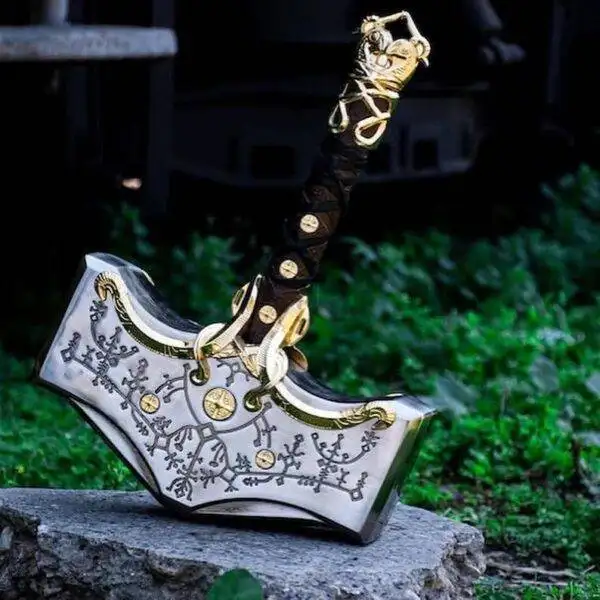
Here is something popular culture gets consistently wrong: Mjolnir is not a long-handled war hammer.
The whole point of the origin myth — the entire reason Loki’s sabotage mattered — is that Mjolnir’s handle is too short. In Viking Age Mjolnir pendant design, the handle is dramatically shorter than the head. The recognisable silhouette — wide, flat head, stubby handle — is historically correct and mythologically significant.
A real Mjolnir replica built to honour the mythology and the archaeological record looks like this:
- Wide, flat rectangular or slightly trapezoidal head — broader than it is tall
- Short, thick handle — proportionally shorter than any conventional hammer
- Heavy forward weight — the head should dominate the balance
- Forged steel — not cast zinc, not resin, not plated aluminium
- Hand-forged detail — the surface should show the work of a smith, not a factory mould
A Viking battle hammer built on these proportions — scaled up from pendant to full weapon size — is one of the most visually striking weapons in the Norse arsenal. Nothing else looks like it. Nothing else carries the same immediate mythological weight.
Buying Guide: How to Choose a Real Mjolnir
The market for Mjolnir replicas ranges from spectacular to embarrassing. Here is how to find the real thing.
Material: The Only Acceptable Answer
High carbon steel, hand-forged.
Not cast iron (brittle, heavy, no grain structure). Not stainless steel (cannot hold an edge, not authentic). Not zinc alloy (costume jewellery masquerading as a weapon). Not resin (not even worth discussing).
A real Mjolnir replica — one worthy of the name — is forged from high carbon steel by a smith who knows what they are doing. The forging process aligns the grain structure of the steel along the head, making it strong, durable, and able to withstand real use.
Scale and Weight
For a display/collector Mjolnir, size can range from pendant-scale to full wall display. Weight should feel substantial — a forged steel head at display size runs 800g to 2kg depending on scale.
For a functional viking battle hammer — a full-size weapon built for HEMA, reenactment, or serious collection — the head should be heavy enough to feel authoritative in the hand. A battle hammer with too light a head is a prop. The weight is part of the point.
Proportions Matter
Check the handle-to-head ratio. If the handle is as long as the head or longer, the maker is not working from the mythology or the archaeological record — they are making a generic fantasy hammer and calling it Mjolnir.
The handle should be noticeably shorter than the head width. That is the identifier. That is what makes it Mjolnir and not just a hammer.
Finish
A quality Mjolnir has either a natural forge finish — the dark, slightly textured surface that comes from the forging process — or a polished working finish for display. Both are correct. What is not correct is chrome plating, powder coating in non-period colours, or decorative paint.
If it looks like a Halloween prop, it is a Halloween prop.
👉 Shop hand-forged Mjolnir hammers at Orion Krafts — built to the mythology, forged in steel
Mjolnir vs. Viking Battle Axe: Which to Choose?
This is genuinely a question people ask — and the honest answer is: they serve different purposes.
A Viking battle hammer (Mjolnir-style) is a statement piece. It is the most mythologically loaded weapon in the Norse arsenal. Its visual weight is unmatched. If you want one object that immediately communicates the full depth of Norse mythology, it is the hammer.
A Viking battle axe is the historically documented primary weapon of Norse warriors. It is more versatile, more common in the archaeological record, and carries the weight of three centuries of actual battlefield use.
Many collectors own both — and the combination of an engraved Norse axe and a Mjolnir hammer displayed together is one of the most visually powerful Norse weapon arrangements you can put on a wall.
👉 Shop Viking battle hammers 👉 Shop Viking battle axes
Frequently Asked Questions
What is Thor’s hammer called? Thor’s hammer is called Mjolnir — pronounced roughly MYOL-neer in modern English, closer to myül-nir in Old Norse. The name likely derives from an Old Norse root meaning lightning or crusher.
What does Mjolnir mean? The exact etymology is debated, but the most widely accepted interpretation is that Mjolnir derives from a Proto-Germanic root meaning to grind or to crush — related to similar words in other Germanic languages meaning lightning. It is essentially the crusher or the lightning weapon.
Is Mjolnir real? No physical Mjolnir weapon exists archaeologically — it is a mythological object. However, over 1,000 Mjolnir pendants have been recovered from Viking Age sites across Scandinavia and Northern Europe, confirming that the symbol was genuinely and widely used in Norse religious practice.
What does Thor’s hammer symbolise? Mjolnir symbolises protection, strength, and divine power. In Norse practice it was used to bless newborns, consecrate marriages, and sanctify the dead. It represented Thor’s role as protector of both Asgard and ordinary humanity — a shield against giants, chaos, and the forces that threatened the world.
What is a Viking battle hammer? A Viking battle hammer is a full-scale functional weapon built in the proportions of the mythological Mjolnir — short handle, heavy wide head, forged steel construction. Used by collectors, HEMA practitioners, and reenactors. Different from a war hammer in European medieval tradition; specifically Norse in design and proportion.
How heavy is Thor’s hammer in Norse mythology? No specific weight is given in Norse sources, but Mjolnir is consistently described as so heavy that only Thor — even with his strength-doubling belt — can lift it. When the giant Thrym attempts to lift Mjolnir, he cannot move it. In modern replicas, a functional battle-size Mjolnir typically runs between 1.5kg and 3kg depending on head size.
Conclusion
Mjolnir is the most powerful object in Norse mythology. Not because of magic. Because of what it meant.
It meant that the strongest force in Asgard stood between humanity and the chaos that wanted to consume it. It meant that a child born into a hard world had divine protection if someone held a hammer over their head. It meant that a warrior going into battle was not alone — that Thor, somewhere in the storm, was aware of them.
A thousand Viking Age pendants. A thousand smiths who spent their best craft on a short-handled hammer. A thousand warriors who died with Mjolnir around their necks.
They were not wrong to trust it.
👉 Own a hand-forged Mjolnir — shop authentic Viking battle hammers at Orion Krafts →
Related Reading:


Add comment